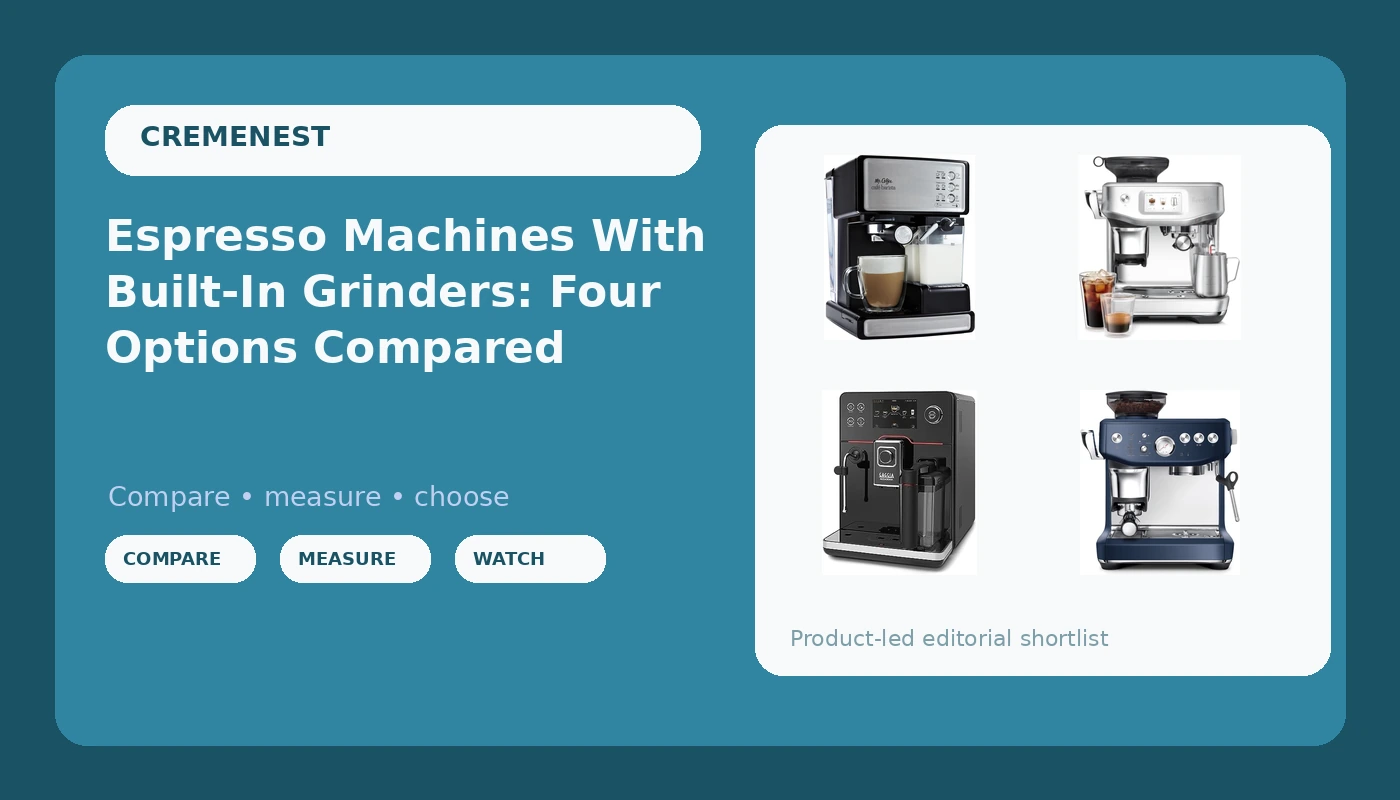
Espresso machines with built-in grinders look like the shortcut that ends the gear conversation: one box, one plug, beans in the top and a shot in the cup. In practice the category splits hard, and the split has almost nothing to do with wattage. Some of these machines ask you to grind, dose, tamp, and pull every shot yourself, with the built-in grinder as the only concession to convenience. Others ask you to press a button and walk away. Both approaches can make excellent coffee, and both can make a miserable kitchen companion if you buy the wrong one for the mornings you actually have. The four machines here sit on different points of that line, so the useful question is not which one is fanciest. It is how much of the workflow you want to own at 6:40 in the morning.
Related: Grinder First, Machine Second: How to Budget a Home Espresso Setup →
Quick answer
Decide by workflow before you decide by brand. If you want to learn extraction and control the variables, a semi-automatic machine with a built-in grinder is the right starting point, and you should expect to add a dedicated burr grinder later if the hobby sticks. If you want a repeatable drink with minimal input, a fully automatic machine delivers that, and you accept that you are buying convenience rather than control. In this group, the two Breville Impress machines sit on the hands-on side, the Gaggia Accademia sits on the one-touch side, and the Mr. Coffee machine is the low-cost entry point for someone testing whether home espresso sticks at all.
Four useful options
| Model | Best fit | What stands out |
|---|---|---|
| Breville Barista Express Impress, Damson Blue | Learning puck prep on a real machine | Impress assisted tamping plus an integrated grinder |
| Breville Barista Touch Impress, Brushed Stainless Steel | Guided, repeatable morning shots | Touchscreen control named in the model line |
| Gaggia Accademia Fully Automatic Espresso Machine | One-touch drinks with no dialing in | 19 customized drink settings, 0.5 liter capacity |
| Mr. Coffee Espresso and Cappuccino Machine | A low-cost first machine | 15-bar pump, automatic milk frother, programmable controls |
The hands-on starting point: Breville BES876DBL Barista Express Impress, Damson Blue
What you buy here is a bridge between a beginner setup and a real one. The built-in grinder is a compromise, and it is worth saying so plainly: it will grind fine enough for espresso and it will do it day after day, but it is not the equal of a dedicated burr grinder costing the same money on its own. The trade is counter space and one purchase instead of two, and for a first machine that trade is usually correct, because the alternative people actually end up with is a decent machine and a blade grinder, which is a worse outcome in the cup. Assisted tamping matters most in month one, when inconsistent puck prep is the thing standing between you and a repeatable shot.
The guided workflow: Breville BES881BSS Barista Touch Impress, Brushed Stainless Steel
The case for this one is the learning curve, not the ceiling. A guided interface shortens the distance between "I have no idea what I am doing" and "this shot tastes like the one yesterday," which is the real beginner problem. Temperature stability is the feature you feel on every shot, and a machine in this class is built to hold it rather than to chase it. What it does not do is remove the grinder from your life forever. At some point you will want to separate grinding from brewing so you can change one variable at a time, and that is a normal progression, not a failure of the machine.
The one-touch option: Gaggia Accademia Fully Automatic Espresso Machine
A fully automatic machine solves a problem the semi-automatics do not even attempt: it makes the same drink twice, on a Tuesday, when you are running late and not paying attention. That is worth real money to a household where one person wants a flat white and another wants a plain espresso and neither wants a lesson in distribution. The honest trade is control. You are not adjusting grind by taste, you are not profiling pressure, and you are not learning why one shot was sour. For a lot of kitchens that is a feature. If it is not a feature to you, this is the wrong category, and no amount of drink settings will change that.
The low-cost entry point: Mr. Coffee Espresso and Cappuccino Machine
This is not the machine you keep for a decade, and it is not trying to be. It is the machine that tells you whether you will actually rinse a portafilter every morning before work. There is a real argument for starting here: the money you do not spend on the machine is money you can put toward a burr grinder, and a modest machine with a good grinder beats an expensive machine with a bad one every single time. Note what this listing is and is not. It has a pump, a frother, and programmable controls. It does not have the kind of grinder that makes dialing in a shot possible, so treat the frother as the feature you are buying and plan the grinder separately.
Prices and availability may change. Product images, names, and retailer links are matched to verified listings. No current price, rating, stock status, or measured result is stated here without current evidence.
Semi-automatic and fully automatic: where the work actually goes
The labels are less mysterious than they sound. A semi-automatic machine gives you a pump, a boiler, and a group head, and leaves the grind, dose, distribution, and tamp to you. A fully automatic machine handles all of that internally: it grinds into a chamber, tamps mechanically, brews, and usually disposes of the puck on its own.
The practical consequence is where your attention goes. On a semi-automatic, the variables are yours, which means a bad shot is information and a good shot is repeatable once you understand why it happened. On a fully automatic, the variables are mostly the machine's, which means consistency arrives immediately and improvement arrives only by changing the settings the machine exposes.
There is a second consequence that gets less attention: the dead time between brewing and steaming. On a single-boiler machine, you wait for the boiler to come up to steam temperature after pulling a shot, and that wait is where a relaxed weekend routine turns into a bottleneck on a weekday. Dual-boiler and thermoblock designs shorten it. If you make milk drinks every morning, this is worth more thought than any spec on the box.
A third consequence is maintenance. Machines that force you to descale constantly are machines you will resent. Built-in grinders need their burrs cleared of oily residue, automatic brew units need rinsing, and water quality determines how often any of it becomes a chore. Soft water or a proper filtration routine is not optional at this price point. It is the difference between a machine that lasts and a machine that becomes a story about the time it leaked.
The grinder decision that outlives the machine
Here is the uncomfortable part of every espresso purchase: the grinder usually matters more than the machine. A great machine fed by an inconsistent grind produces inconsistent shots, and an inexpensive machine fed by a consistent grind produces good ones. That asymmetry should shape your budget before you look at a single listing.
There is also the matter of basket pressure. Pressurized baskets are marketed as beginner-friendly because they generate crema regardless of grind quality, and they do. But they also mask stale beans and sloppy technique, which means you can spend a year making coffee without ever learning to taste what changed. Treat a pressurized basket as training wheels you intend to remove, not as a feature you paid extra for.
If you plan to stay in this hobby, a professional-standard 58mm portafilter is worth prioritizing, because the accessory ecosystem is built around it and smaller baskets are less forgiving of small mistakes.
A practical sequence for choosing:
- Set a total budget for machine and grinder together, not for the machine alone.
- Decide honestly how many milk drinks you make per morning, because that determines how much the steam workflow matters.
- Choose the category first, semi-automatic for control or fully automatic for consistency, and only then compare models within it.
- Measure your counter and your clearance under the cabinets before ordering anything.
- Check what the machine needs for water and cleaning, and confirm you will actually do it.
Matching the machine to your counter and your mornings
- Count the milk drinks. One latte a day justifies caring about steam power and recovery time; black espresso only does not.
- Measure twice. These machines are tall, and a machine that does not fit under the cabinet is a machine that lives on a cart.
- Budget the grinder separately if the machine does not include one, and do not skip this step to afford a nicer machine.
- Plan the water. Filtered water or a softener extends the interval between descaling sessions and protects the boiler.
- Be honest about month three. Buy for the routine you will keep, not the one you imagine on a slow Sunday.
Which option should you choose?
Choose the Breville BES876DBL Barista Express Impress, Damson Blue when you want to learn the craft on a machine that keeps grinding and brewing in one body and assists with tamping. Choose the Breville BES881BSS Barista Touch Impress, Brushed Stainless Steel when you want the same hands-on family with more guidance on screen while you build the habit. Choose the Gaggia Accademia Fully Automatic Espresso Machine when consistency and one-touch drinks matter more to your household than dialing in a shot yourself. Choose the Mr. Coffee Espresso and Cappuccino Machine when you want the lowest-cost way to find out whether home espresso becomes part of your week, and you are prepared to add a real grinder separately.
One caveat applies to all four: nothing here is a substitute for fresh beans and a grinder you trust. None of these listings states a current price, a rating, or a measured result, and none of that should be inferred from this article. Match the machine to the workflow you will actually keep.
The bottom line
The category question comes first and the model question comes second. If you want control, a semi-automatic machine with a built-in grinder gets you pulling shots this week and teaches you something every time the result changes. If you want the drink without the ritual, a fully automatic machine delivers it with less ceremony and less room to tinker. Either way, spend your money where it shows up in the cup, which is the grinder and the beans, and spend it on the workflow you will still be running in month three.