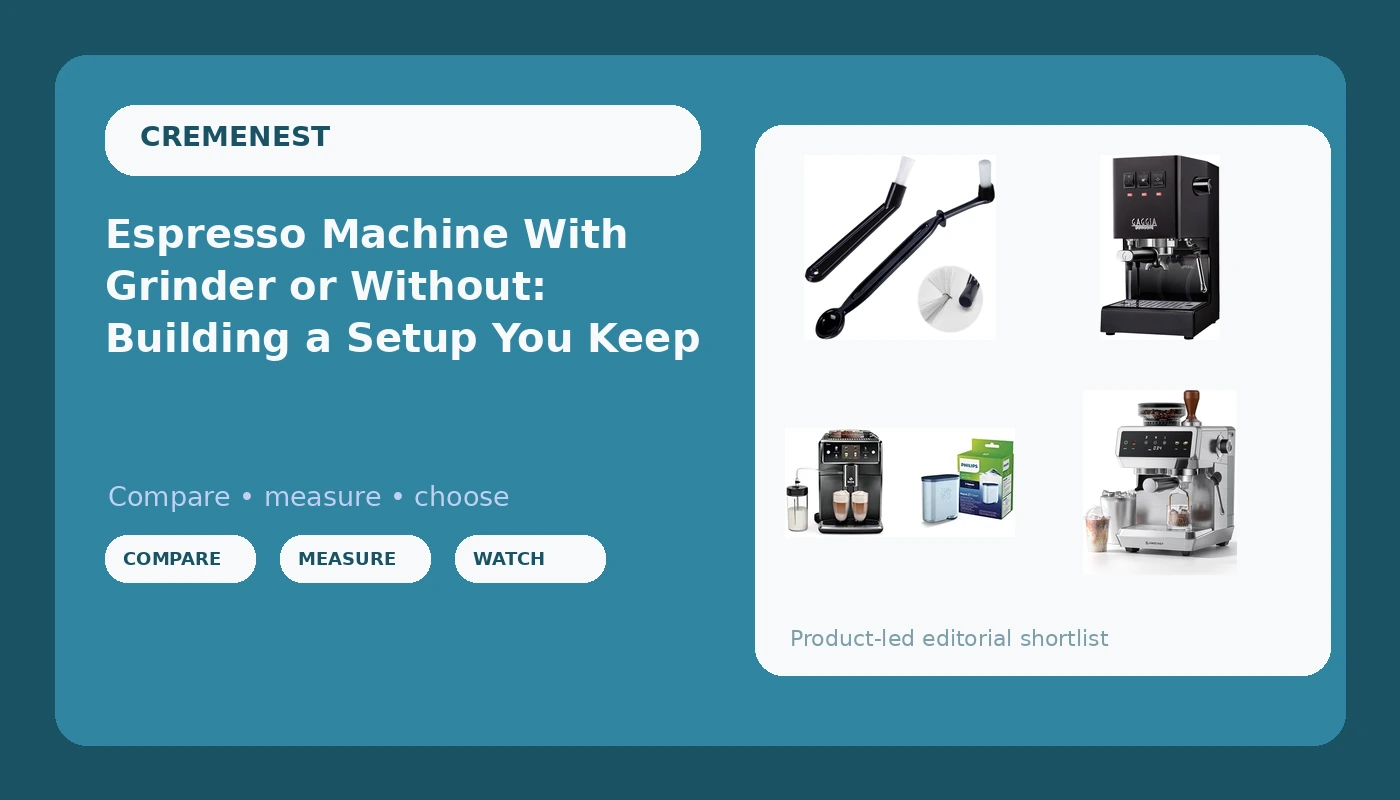
Most people shopping for their first serious setup start with the machine and work backward. That is the wrong order, and it is why so many counters end up holding an expensive machine nobody wants to use by month three. The real question is not which espresso machine with grinder looks most impressive on a product page. It is what your actual morning looks like. Do you want to weigh beans, adjust a grind setting, and pull a shot with your hand on the lever, or do you want to press one button and walk away with a cup? The four options below sit at different points on that spectrum, and one of them is not a machine at all. It is the cleaning kit that decides whether the other three keep working.
Related: How to Dial In an Espresso Grinder Without Wasting Beans →
Quick answer
Pick the workflow first, then the machine. If you want to learn the craft and are willing to buy a grinder separately, a traditional semi-automatic like the Gaggia Classic Evo Pro is the honest starting point. If you want one box, one plug, and a grinder built in, the AMZCHEF machine covers that ground. If you want a super automatic that grinds, tamps, and brews on its own, the Saeco Xelsis is that category. Whichever you choose, add a brush set, because group heads and grinders need cleaning far more often than most people expect. None of these is a shortcut around fresh beans and a grind you have actually dialed in.
4 useful options
| Model | Best fit | What stands out |
|---|---|---|
| Gaggia RI9380/49 Classic Evo Pro Espresso Machine, Thunder Black, Small | Learning the craft with a separate grinder | Traditional semi-automatic workflow in a compact, small-format body |
| AMZCHEF Espresso Machine With Grinder, Temp Control, 44 Grind Settings | One-box setup on a tighter budget | Built-in grinder with 44 grind settings and temperature control |
| Saeco Xelsis Super Automatic Espresso Machine, Titanium Metal Front, SM7684/04 with Philips AquaClean Filter Single Unit, CA6903/10 | Push-button mornings with no dialing in | Super automatic brewing plus an included AquaClean water filter |
| Coffee Machine Cleaning Brush Set, 2 Pieces Espresso Cleaner Brushes with Spoon Tool | Keeping any of the above running | Group head brush, grinder brush, and a spoon tool in one kit |
The enthusiast starting point: Gaggia RI9380/49 Classic Evo Pro Espresso Machine, Thunder Black, Small
Nothing in this listing promises a built-in grinder, and that is the point. A machine like this puts the grind decision where it belongs, in a separate grinder you choose on purpose. The trade-off is honest: you get a steeper first month, and in exchange you get a workflow you can adjust rather than a program you have to accept. This is the route to take if you enjoy the process and want a machine that rewards small changes instead of hiding them.
The all-in-one starter: AMZCHEF Espresso Machine With Grinder, Temp Control, 44 Grind Settings
The appeal here is counter space and simplicity. You are not matching a machine to a grinder, you are not budgeting for two purchases, and you are not learning two workflows at once. The trade-off is flexibility: when you eventually want a different grinder, you are replacing part of the machine rather than adding a component beside it. For a first setup, or for a kitchen where one appliance has to do the whole job, that is often the right compromise.
The push-button route: Saeco Xelsis Super Automatic Espresso Machine, Titanium Metal Front, SM7684/04 with Philips AquaClean Filter Single Unit, CA6903/10
Super automatics solve a specific problem: nobody in the house wants to learn to dial in a shot. They are the wrong purchase for someone who enjoys the ritual and the right one for a busy kitchen where three people want coffee at 7 a.m. The included AquaClean filter is more interesting than it looks, because water is the part of espresso almost nobody budgets for, and hard water is what turns a machine into a descaling project. If you go this route, treat the filter as part of the running cost, not a freebie.
The maintenance kit: Coffee Machine Cleaning Brush Set, 2 Pieces Espresso Cleaner Brushes with Spoon Tool
This is the least glamorous item in the article and the one most likely to change how your coffee tastes. Old grounds sitting in a group head go rancid, and a grinder burr set that never gets brushed carries yesterday's coffee into today's shot. A brush set costs very little next to any machine here, and it is the difference between a setup that stays consistent and one that slowly drifts toward tasting muddy.
Prices and availability may change. Product images, names, and retailer links are matched to verified listings. No current price, rating, stock status, or measured result is stated here without current evidence.
Why the grinder decides the shot, not the machine
Ask anyone who has spent time behind a bar and you will hear a version of the same rule: the grinder is most of the result. That is not marketing for expensive grinders, it is physics. Espresso is a small amount of coffee asked to do a lot in a short time, and the only variable that changes how fast water moves through the puck is how evenly the grounds are sized. A machine controls pressure and temperature. The grinder controls whether the puck is a consistent filter or a mix of dust and pebbles.
This is why the pressurized basket debate matters so much. A pressurized basket forces the shot through a small opening to fake resistance, which means it will produce something crema-like from almost any grind, including stale pre-ground coffee. It is a crutch, and it hides exactly the feedback you need to learn from. If your goal is a shot that tastes better than the cafe down the street, you want a real basket and a grinder that can choke the machine if you go too fine.
That also explains the sequencing advice you will hear over and over. If your total budget is fixed, put the larger share into the grinder and buy the machine that fits what is left. A modest machine paired with a capable grinder will out-drink an expensive machine fed by a blade grinder or a tired burr set, every single morning. The machines in this article are all capable of good shots. The variable you control is what feeds them.
Boiler design, dead time, and temperature stability
The marketing language around espresso machines leans on pressure profiling and pre-infusion, because those sound technical. The spec that actually shows up in every cup is temperature stability: how steady the brew water stays across the twenty-five or thirty seconds of a shot. A machine that swings a few degrees between shots gives you a shot that tastes great, then sour, then bitter, with no change in your technique. Chasing that inconsistency is where most home baristas burn their first month.
Boiler design is the reason. A single boiler has to heat water for brewing and then heat the same water further for steam, which creates dead time, the wait between pulling a shot and steaming milk. If you drink milk drinks back to back, dead time is where the workflow dies. Heat exchangers and dual boilers remove that wait by keeping brew and steam water separate, and they generally hold temperature more steadily across consecutive shots.
None of that means a single boiler is a bad choice. It means you should know which one you are buying before you buy it. If your routine is one espresso in the morning and a flat white on weekends, dead time is a minor annoyance. If you are making four milk drinks for a household every day, it is the feature you will notice most, long after the novelty of any other specification has worn off.
- Decide how many drinks you make in a row on a normal morning, not a holiday morning.
- Decide honestly whether you want a hobby or a beverage, because those lead to different machines.
- Set a total budget for machine plus grinder, then split it with the grinder taking the larger share.
- Choose between built-in grinding, a separate grinder, or a super automatic based on that answer.
- Add cleaning supplies and a water plan to the same order, because both affect taste more than most upgrades.
Setting up the counter without regrets
- Measure the space above the machine, not just the width, since filling a reservoir often needs clearance.
- Leave room beside the machine for a tamping mat and a knock box, or you will improvise badly.
- Plan for water. A filter or a soft-water routine protects the machine and improves the shot.
- Keep a brush within arm's reach so cleaning happens daily instead of after a taste problem appears.
- Buy beans you can repurchase easily, because dialing in a new roast every week teaches you nothing.
- Write down the grind setting that worked for your current beans, since the next bag will need a new one.
Which option should you choose?
Choose the Gaggia RI9380/49 Classic Evo Pro Espresso Machine, Thunder Black, Small when you want a hands-on semi-automatic and you are ready to buy a separate grinder and learn the workflow. Choose the AMZCHEF Espresso Machine With Grinder, Temp Control, 44 Grind Settings when you want a single appliance with grinding built in and a wide range of grind settings to work with. Choose the Saeco Xelsis Super Automatic Espresso Machine, Titanium Metal Front, SM7684/04 with Philips AquaClean Filter Single Unit, CA6903/10 when nobody in the house wants to dial in a shot and the goal is a good cup with one press. Choose the Coffee Machine Cleaning Brush Set, 2 Pieces Espresso Cleaner Brushes with Spoon Tool regardless of which machine you pick, because all three of the others need it.
One caveat worth stating plainly: listings, bundles, and included accessories change between revisions, and a machine sold today may ship with different packaging or a different bundled filter than the same model did last year. Confirm what is actually in the box on the current listing before you commit, and treat any single article, including this one, as a starting point rather than a final answer. Your beans, your water, and your grinder will move the taste more than any spec sheet.
The bottom line
The machine is the visible purchase, but the workflow is what you live with. A traditional semi-automatic asks more of you and gives more back. A machine with a built-in grinder trades flexibility for simplicity. A super automatic trades control for convenience, and the included water filter is a reminder that water is part of the recipe, not an afterthought. Add a brush set to whichever you choose, keep your beans fresh, and spend the money on the grind before you spend it on the badge on the front. Check current Amazon price on each listing before you decide, since availability and bundles shift through the year.