Related: Espresso Machine Temperature Stability, Explained
I have pulled something over 40,000 shots in twelve years, first behind a bar and now in a garage that has become a machine graveyard. In all of that time I have never once seen an espresso machine and grinder setup succeed because the machine was expensive. It works when four things are right: a grinder that can actually dial in, a basket that does not fight the puck, a machine with temperature stability and no dead time, and a cleaning routine you will keep past week three.
The four products below are those four pieces. One is the machine, one is the grinder, one is a cheap upgrade that changes the shot, and one is the boring purchase that keeps the other three alive. If you read nothing else, read the grinder section first, because that is where the money should go.
Best Overall: Chefman Crema Deluxe Espresso Machine
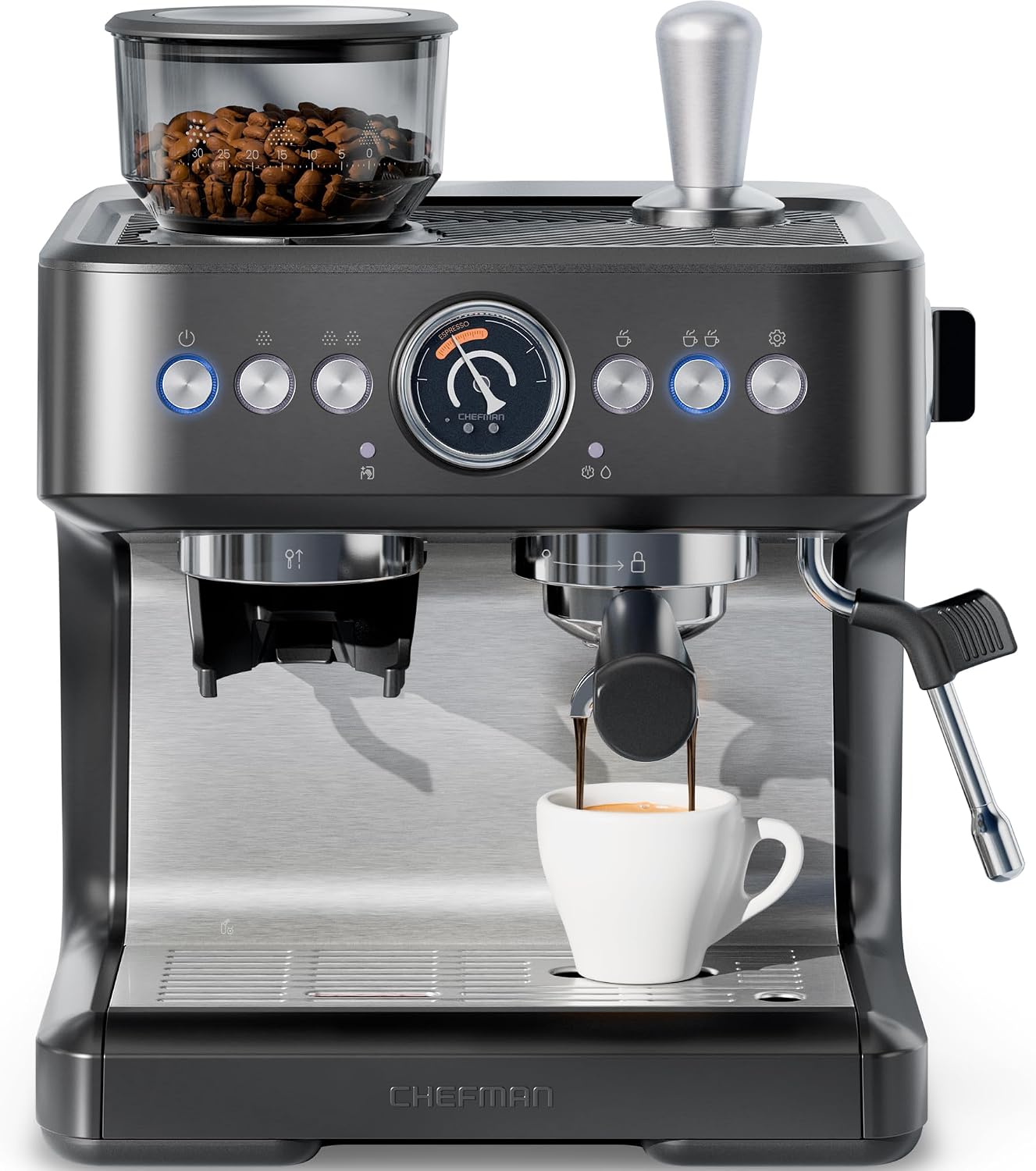
The Crema Deluxe is the one box that covers a whole morning. The product name says it plainly: double boiler, milk frother and brew at the same time, a built-in grinder with 30 grind settings, and a steam wand. For a kitchen that has never had a real espresso station, that solves a lot of workflow in a single footprint.
The double boiler is the part I care about most. On a single boiler machine you pull your shot, then you wait while the machine climbs to steaming temperature, and by the time steam is ready the shot has gone from "drink it now" to "drink it anyway." That wait is dead time, and dead time is where home espresso quietly dies. Brewing and steaming at the same time is not a luxury feature. It is the difference between making a flat white twice a week and making one twice a year.
Thirty grind settings is a range, and I want to be honest about ranges. What matters is not the number. What matters is whether the finest steps are fine enough to choke the machine, and whether the steps are small enough that one notch does not blow up your shot. Built-in grinders are a compromise by design, and that is not a knock on this machine specifically. It is physics and price. A grinder sized to live inside a machine at this price is not the same grinder as a dedicated unit.
So treat the built-in grinder as a starting point, not a finish line. Buy beans with a roast date rather than a best-by date. Dial in by taste: sour and thin means grind finer, bitter and dry means grind coarser, and move one notch at a time. The Crema Deluxe earns its place because it gets you pulling shots on day one instead of comparison shopping for three months. Check current Amazon price.
The Grinder That Decides Everything: 1Zpresso J-Max
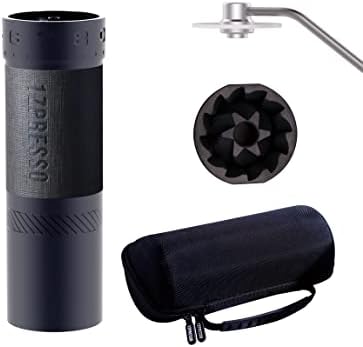
If you take one thing from a barista of twelve years, take this: the grinder is roughly 70% of the shot. A $500 machine with a real grinder beats a $2,000 machine fed by a blade grinder, every single morning, and it is not close. The J-Max in Iron Gray is the shortcut into that first camp without spending electric grinder money.
It is a manual grinder, which means the motor is your arm and the payoff is burr quality per dollar. Hand grinding for espresso is not the chore people imagine, but it is a ritual. You weigh beans, you crank, you knock the grounds out, you tamp. If you make one or two drinks a day, that ritual is a feature. If you are building four milk drinks back to back for a house full of people, it is a real bottleneck, and you should know that before you buy rather than after.
What a dedicated espresso grinder buys you is repeatability at the narrow end of the range. Espresso lives in a small window. A tiny change in grind changes the shot a lot, and a grinder that cannot make small changes leaves you stuck between gushers and choked shots with nothing usable in between. A grinder built for espresso gives you steps you can actually use, which is the difference between dialing in and guessing. It also sits on the counter as its own object, so it does not become landfill when the machine eventually dies. My current grinder has outlived four machines. That is not an accident, it is a budget strategy.
Pair it with the machine above and you have the setup I would build for myself on a normal budget: a machine that handles brew and steam at once, and a grinder that lets you dial it in. Check current Amazon price.
The Cheapest Real Upgrade for a 54mm Breville: IMS Precision Basket
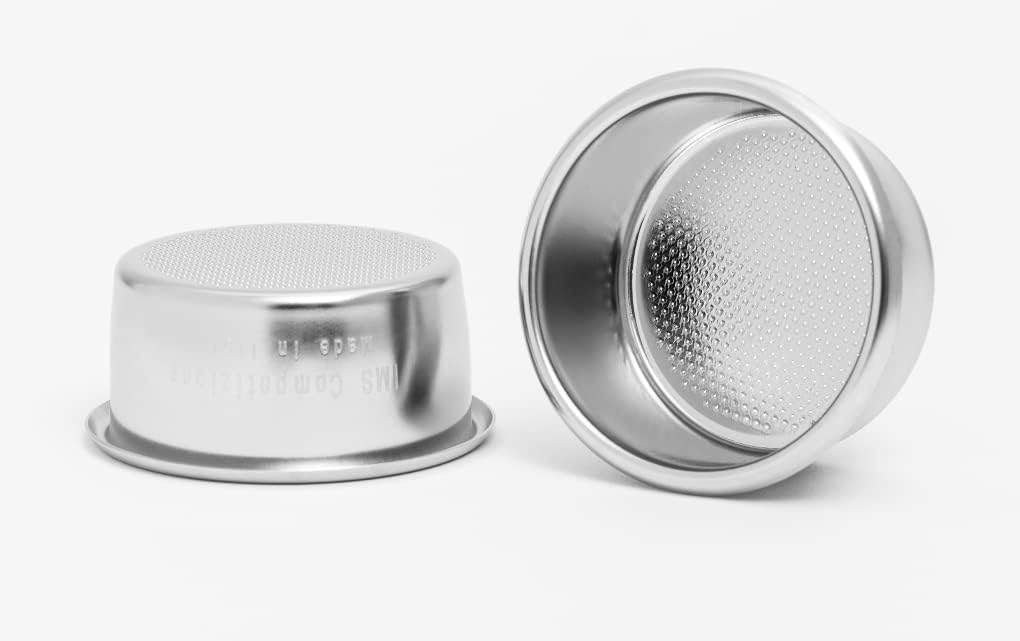
If you already own a Breville or Sage machine with a 54mm portafilter, this is the upgrade I would make before I bought anything else. The IMS Precision 18-22 g filter basket fits the Express, Bambino, Bambino Plus, Barista Pro, Impress, Barista Touch, and Infuser. It does not fit the JET model, so check your machine before you order.
Here is the argument. Stock baskets are stamped out to a price, and the holes are not perfectly uniform. A precision basket is manufactured to tighter tolerances, which means water reaches the puck more evenly and your shot becomes less of a lottery. On a 54mm machine this matters more than it does on a 58mm, because a smaller basket means a deeper, narrower puck, and an uneven puck in a narrow basket punishes you. You cannot fix that with a more expensive machine. You fix it at the basket.
The 18-22 g range is the other useful part. It lets you choose your dose instead of being locked into whatever the stock basket happens to hold. A lighter dose with a finer grind and a heavier dose with a coarser grind can both be good shots. They taste different, and having the range means you can find the one you like instead of arguing with the hardware. Start around 18 g, adjust from there, and change one variable at a time so you know what actually did something.
This is also the purchase that makes the grinder worth owning. A precision basket reveals what your grinder is doing. If your grind is inconsistent, you will taste it here first, in a way the stock basket happily hid from you. Check current Amazon price.
The Boring Purchase That Keeps the Machine Alive: Backflush Cleaning Disc
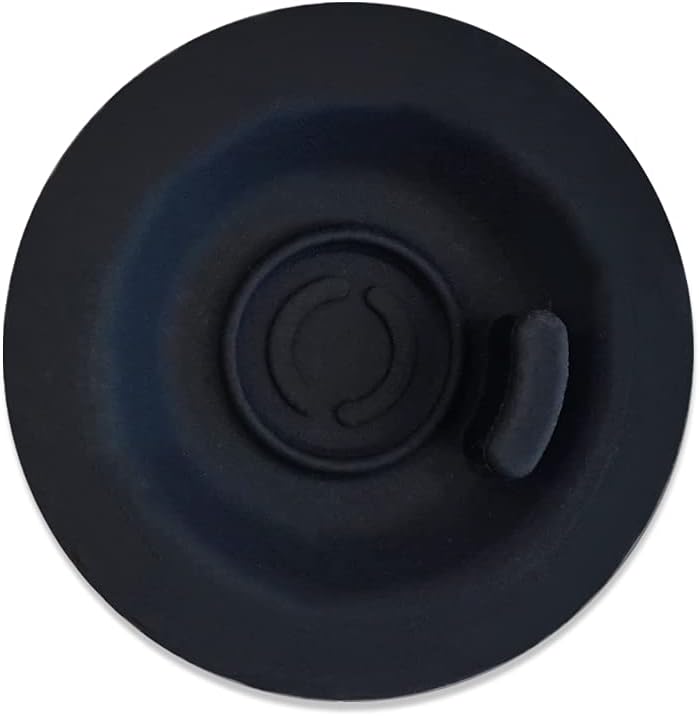
Nobody wants to spend money on this, and everybody who skips it ends up buying a machine sooner. The backflush cleaning disc is a 54mm blank for Breville espresso machines, and it is compatible with cleaning tablets. One pack is all you need, because this is reusable hardware, not a consumable.
The routine is simple. You drop the disc into the basket, add a cleaning tablet, lock the portafilter in, and run the pump in short cycles so the detergent backflushes through the group and the internal plumbing. Then you rinse and repeat with plain water until it runs clear. Do it on a schedule rather than when you notice a problem, because the problem you notice is stale oil in the group head showing up in the cup. That flavor is not subtle. It tastes like a diner that has not cleaned its grinder since 2019.
This is the cheapest insurance in the entire article. A machine with a clean group and a clean solenoid pulls consistent shots for years. A machine that never gets backflushed develops a slow decline that most people blame on their beans, their grinder, or the weather. If you take care of nothing else on this list, take care of this. Check current Amazon price.
How I judge a home espresso setup
Four questions, every time.
First, what is the real boiler setup, not the marketing version? Brew and steam at once, or wait? Second, does the grinder actually grind fine enough for espresso, and can it make small enough changes to dial in? Third, how long is the dead time between pulling a shot and steaming milk? Fourth, would I still enjoy using this in month three, after the novelty has worn off?
That last question is the one that separates a good recommendation from a bad one. Most machines are fun in week one. The ones worth keeping are the ones where the workflow still makes sense when you are half awake on a Tuesday and the beans are three weeks old.
I also refuse to recommend a machine without grinder advice. It is the most common mistake I see. Someone spends the entire budget on the machine, buys pre-ground coffee, and concludes that home espresso is a lie. It is not a lie. The grinder is where the flavor lives, and the basket plus the cleaning routine are what let the grinder do its job.
The setup at a glance
| Product | What it is | Who it is for | Price |
|---|---|---|---|
 Visit on Amazon → Chefman Crema Deluxe Espresso Machine |
Machine with double boiler, built-in grinder, steam wand, 30 grind settings | A first real station where brew and steam happen together | $329.99 |
 Visit on Amazon → 1Zpresso J-Max, Iron Gray |
Dedicated manual espresso grinder | One or two drinks a day, and anyone who wants the grinder to outlast the machine | Check current Amazon price |
 Visit on Amazon → IMS Precision 18-22 g filter basket |
54mm precision basket for Breville and Sage, not JET | Breville owners chasing an even extraction | $15.88 |
 Visit on Amazon → Espresso backflush cleaning disc |
54mm backflush disc for Breville machines, works with cleaning tablets | Anyone who owns a Breville and wants it to keep working | $5.69 |
The order in that table is the order I would buy in, with one caveat. If you already own a Breville, start at the bottom of the table and work up. The basket and the disc are the cheapest changes with the fastest payoff, and they make the machine you already own taste better before you spend a cent on a new one.
Should you buy the Chefman Crema Deluxe?
Yes, if your kitchen has no espresso setup at all and you want to be pulling shots this weekend. Double boiler, simultaneous brew and steam, and a built-in grinder that will teach you the workflow while you save for a dedicated grinder. No, if you already own a working machine and a decent grinder, because that money belongs in the grinder column first.
Should you buy the 1Zpresso J-Max?
If you make one or two drinks a day and you want the most grind quality per dollar, yes. The grinder is where the flavor is, and a dedicated manual espresso grinder gets you into good-shot territory without electric grinder money. If you are steaming milk for a family every morning, buy the one-box machine first and save for an electric grinder later. That is not a compromise, it is sequencing.
Should you buy the IMS basket and the backflush disc?
Both, and in that order if you have to split the purchase. The basket changes what is in the cup today. The disc changes whether the machine is still worth using in three years. Neither one is exciting, and both of them are the reason the exciting purchases keep working. That is the whole lesson of a home espresso station: the cheap parts carry the expensive ones.