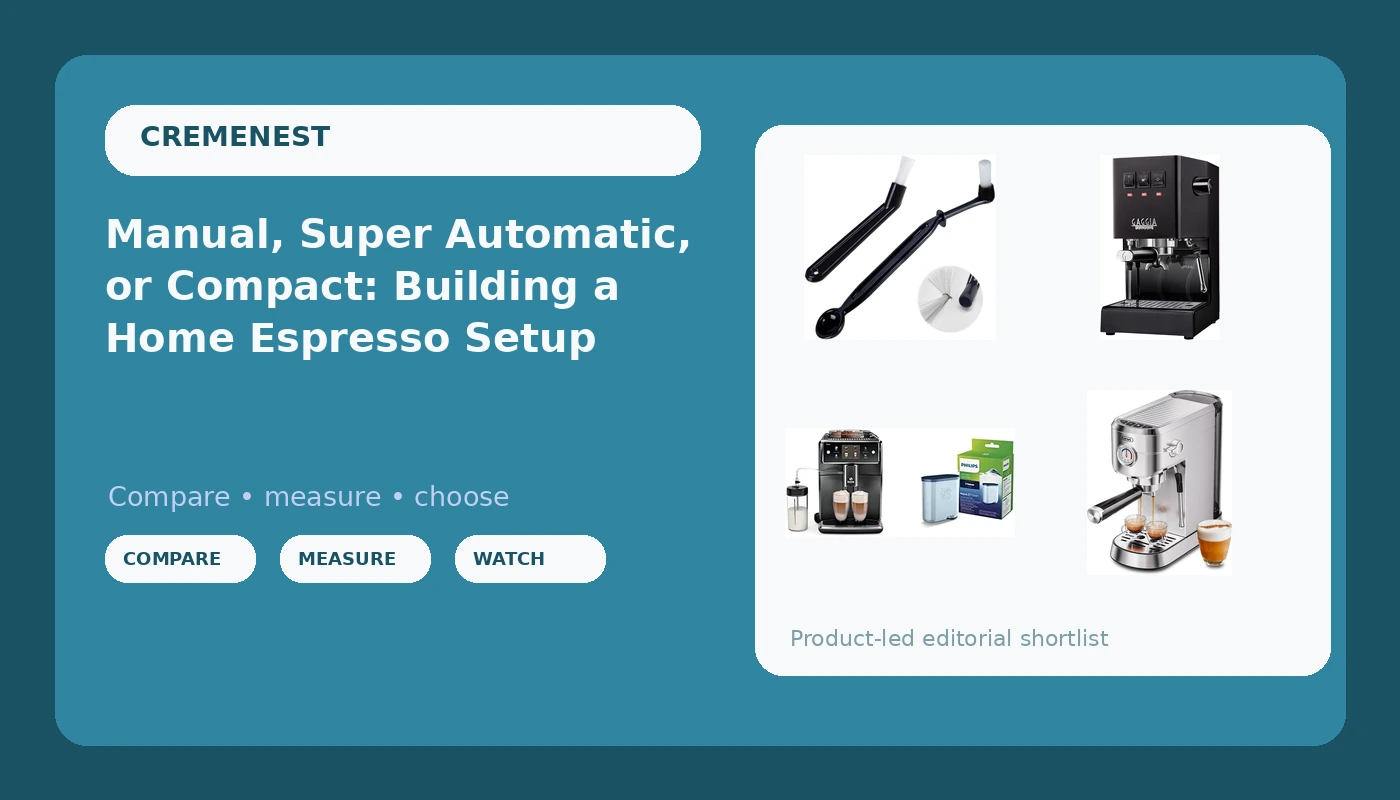
Most people build a home espresso setup by shopping for a machine first, then discovering that the machine was never the hard part. The things that actually end up in the cup, grind size, dose, water quality, brew temperature, and how clean the group head is, rarely appear on the box. What the box does tell you is the format: manual, compact semi-automatic, or super automatic, and that format decides your morning routine more than any spec line. This explainer walks through the three machine approaches that dominate the category right now, plus the maintenance item that keeps any of them from tasting like last week's coffee. Read it as a map of workflows, not a scoreboard.
Related: Grinder First: Why Your Espresso Budget Order Matters →
Quick answer
The machine should follow the workflow, not the other way around. If you want to learn extraction and you are willing to weigh doses and adjust a grinder, a manual machine like the Gaggia Classic Evo Pro gives you the most room to grow. If your counter is tight and you want a milk drink without a ritual, the Gevi 20 bar compact machine matches that. If nobody in the house wants to touch a portafilter, the Saeco Xelsis super automatic runs the whole sequence itself. In every case, plan for two things the machine does not include: a grinder that can actually grind espresso-fine, and a brush set for cleaning.
4 useful options
| Model | Best fit | What stands out |
|---|---|---|
| Gaggia RI9380/49 Classic Evo Pro Espresso Machine, Thunder Black, Small | Someone who wants to run the shot themselves | A manual machine from Gaggia's long-running Classic line, in a compact Thunder Black body |
| Gevi 20 Bar Compact Espresso Machine for Home,Latte、Cappuccino Coffee Maker | Small kitchens and milk drinks | 20 bar pump rating in a compact home format, positioned for latte and cappuccino |
| Saeco Xelsis Super Automatic Espresso Machine, Titanium Metal Front, SM7684/04 with Philips AquaClean Filter Single Unit, CA6903/10 | A household that wants one-button drinks | Super automatic operation with a titanium metal front and a bundled Philips AquaClean filter |
| Coffee Machine Cleaning Brush Set, 2 Pieces Espresso Cleaner Brushes with Spoon Tool | Anyone who owns one of the above | Two pieces, a group head brush plus a spoon tool, with nylon and stainless steel bristles |
Manual control: Gaggia RI9380/49 Classic Evo Pro Espresso Machine
The trade-off with a machine in this class is time and attention. A manual machine asks you to grind, dose, tamp, and watch the shot, and it asks you to learn what a good one tastes like before you can repeat it. In exchange you get control that a push-button machine cannot give you: you can change one variable at a time and taste the result. The Classic line also has a deep parts and modification culture around it, which matters if you keep machines for a decade instead of a season. Where this format stumbles is milk. Single-boiler designs in general force you to brew, then wait, then steam, so a round of flat whites for four people becomes a project. If your household drinks mostly straight espresso, that wait costs you nothing. If it drinks mostly lattes, budget your patience along with your beans.
Compact and straightforward: Gevi 20 Bar Compact Espresso Machine
Two things are worth understanding before you buy into this category. First, the bar number on the box describes the pump, not the pressure at the coffee puck; nearly every home machine is designed to deliver somewhere near the traditional 9 bar range at the group, and a higher pump rating mostly tells you about the pump. Second, compact machines often use smaller portafilters and sometimes ship with a pressurized basket, which is a crutch that hides stale beans and an inconsistent grind. That is not automatically disqualifying, because a pressurized basket also makes a cheap setup drinkable while you save for a grinder, but you should know which one you are buying. Check the listing carefully for basket type and portafilter size, and if the machine comes with both, learn on the standard basket and keep the pressurized one for guests.
Hands-off automation: Saeco Xelsis Super Automatic Espresso Machine
Super automatics solve a social problem rather than a technical one. Nobody in the house has to learn to tamp, nobody has to stand at the machine at 6 a.m., and the drink arrives at the press of a button. The trade is control: the grinder is inside the machine, the dose is decided by software, and the ceiling of the cup is largely fixed by the factory rather than by your skills. Super automatics also add maintenance chores you do not get with a manual machine, including a bypass for the brew group, regular rinsing cycles, and a water filter on a replacement schedule. The included AquaClean cartridge is designed to treat water and extend the interval between descaling, which matters in hard-water cities. Treat the filter as a consumable to keep buying, not a one-time accessory, and check what a replacement cartridge costs before you commit to the machine.
The accessory: Coffee Machine Cleaning Brush Set
Cleaning is the least glamorous purchase in espresso and the one that changes flavor fastest. Old coffee oils on a shower screen and gasket go rancid within days, and that bitterness shows up in the cup before any machine upgrade will fix it. A brush lets you knock loose grounds out of the group head between sessions and sweep the grinder chute, where retained grounds stale and then dump into your next shot. A spoon tool is there for the small jobs, stirring a basket or scooping out a portafilter, and it costs nothing extra in a set like this. Keep the brush next to the machine, not in a drawer, because the habit only survives if the tool is within reach.
Prices and availability may change. Product images, names, and retailer links must be matched by verified ASIN. Do not state a current price, rating, stock status, or measured result without current evidence.
Why machine format changes your morning
The honest reason format matters more than features is that it decides who makes the coffee and how long it takes. A manual machine with a single boiler runs a simple loop: heat water, brew, then switch to steam and wait for the boiler to climb. That wait is what home baristas call dead time, and it is the single biggest reason people abandon a manual machine they otherwise like. Machines with separate boilers or heat exchangers remove that wait, which is why they cost more and why they matter to anyone making several milk drinks in a row. Temperature stability is the other invisible variable. A machine that holds a steady brew temperature across a shot produces consistent espresso; one that swings produces a shot that is sometimes sweet and sometimes sour from the same beans. Neither of those traits shows up in a marketing bullet, which is why the format and the boiler setup, not the pump rating, deserve your attention.
Super automatics sit at the far end of the same trade. They remove the learning curve and the dead time in one move, and they take away your ability to change much when the shot is not to your taste. You can adjust grind and strength within the machine's menu, but you cannot change the pressure profile or swap in a different basket. For a household with mixed schedules and mixed skill levels, that is often a fair trade. For someone who wants to chase a specific flavor, it is a ceiling.
What the spec sheet does not tell you
Box copy is written to sell, and espresso has a few numbers that get used as shorthand for quality when they are nothing of the kind. The pump rating is the clearest example. Pressure at the puck is what extracts coffee, and every home machine regulates that pressure somewhere after the pump, so a higher number on the box does not mean a better shot. Portafilter diameter matters more than most buyers realize. Larger baskets hold deeper pucks, which are more forgiving of distribution errors and easier to dial in, while very small baskets leave you with less margin for a bad grind. If you are comparing two machines and one uses a standard commercial size, that is a real advantage in the long run.
The grinder is the second thing the spec sheet hides. A machine with a built-in grinder is convenient, but its burrs are chosen to hit a price, and espresso-fine grinding is demanding work. A separate grinder at the same total budget usually produces a better shot than a machine with the grinder folded in, which is why the order of spending matters so much. Water is the third. Hard water scales a boiler and a super automatic's internals, and soft or filtered water slows that down. The AquaClean filter bundled with the Saeco is one answer to that problem; on a manual machine, filtered water and a regular descale are the equivalent.
- Count the drinks your household actually makes on a weekday, not on a Sunday.
- Measure your counter and note the height clearance under your cabinets before you shop.
- Decide who operates the machine, and whether they will learn a manual routine.
- Set the grinder and water budget before you pick the machine, not after.
- Plan the cleaning routine now: brush, backflush, and descale on a schedule you will keep.
Practical guidance for a real kitchen
- Buy the machine you will still enjoy in month three, not the one that looks good in a photo.
- Reserve counter space for a grinder, a tamper, and a knock box, not just the machine.
- If you drink mostly milk drinks, weigh how long the machine takes to switch from brew to steam.
- If your water is hard, price a filter or a descaling routine into the total cost of ownership.
- Keep a brush at the machine and clean the group head daily; it is the cheapest flavor upgrade available.
- Check the basket type on any compact machine, because a pressurized basket changes how you dial in.
Which option should you choose?
Choose the Gaggia RI9380/49 Classic Evo Pro Espresso Machine when you want manual control, plan to learn extraction, and mostly drink straight espresso or a single milk drink at a time. Choose the Gevi 20 Bar Compact Espresso Machine when counter space is the binding constraint and you want a simple, milk-friendly setup without a large footprint. Choose the Saeco Xelsis Super Automatic Espresso Machine when the household wants one-button drinks, several people share the machine, and nobody wants to learn a manual workflow. Whatever you pick, add the Coffee Machine Cleaning Brush Set, because every one of these formats needs the same basic upkeep.
One caveat applies to all four. None of these listings tells you how the machine will taste with your beans, your grinder, and your water, and none of them replaces the grinder that does most of the work. Treat the machine as one part of a system and the decision gets much easier.
The bottom line
A home espresso setup is a workflow decision wearing a product label. Manual machines trade convenience for control and reward the person willing to learn. Compact machines trade some ceiling for space and simplicity. Super automatics trade control for a routine that survives a busy household. Spending your budget in the right order, grinder and water first, machine second, maintenance always, matters more than any single feature on a spec sheet. Pick the format that matches the mornings you actually have, then give it good beans and a clean group head, and it will outperform a more expensive machine that nobody bothers to maintain.