Walk into any appliance aisle and the labels stop meaning much: 20 bar, barista-grade, automatic. None of them tell you what a machine feels like at 6:45 on a Tuesday morning, which is the only test that really counts. I have pulled a lot of shots in my life, and the pattern repeats: people choose home espresso machines before they understand the workflow they are signing up for. The machine is the fun part. The grinder, the dosing, the cleaning, and the wait between brewing and steaming are the parts you live with every day. This guide lays out four real options at four different levels of involvement and explains what each one asks of you before you spend anything.
Related: How Much Should You Spend on an Espresso Grinder? →
Quick answer
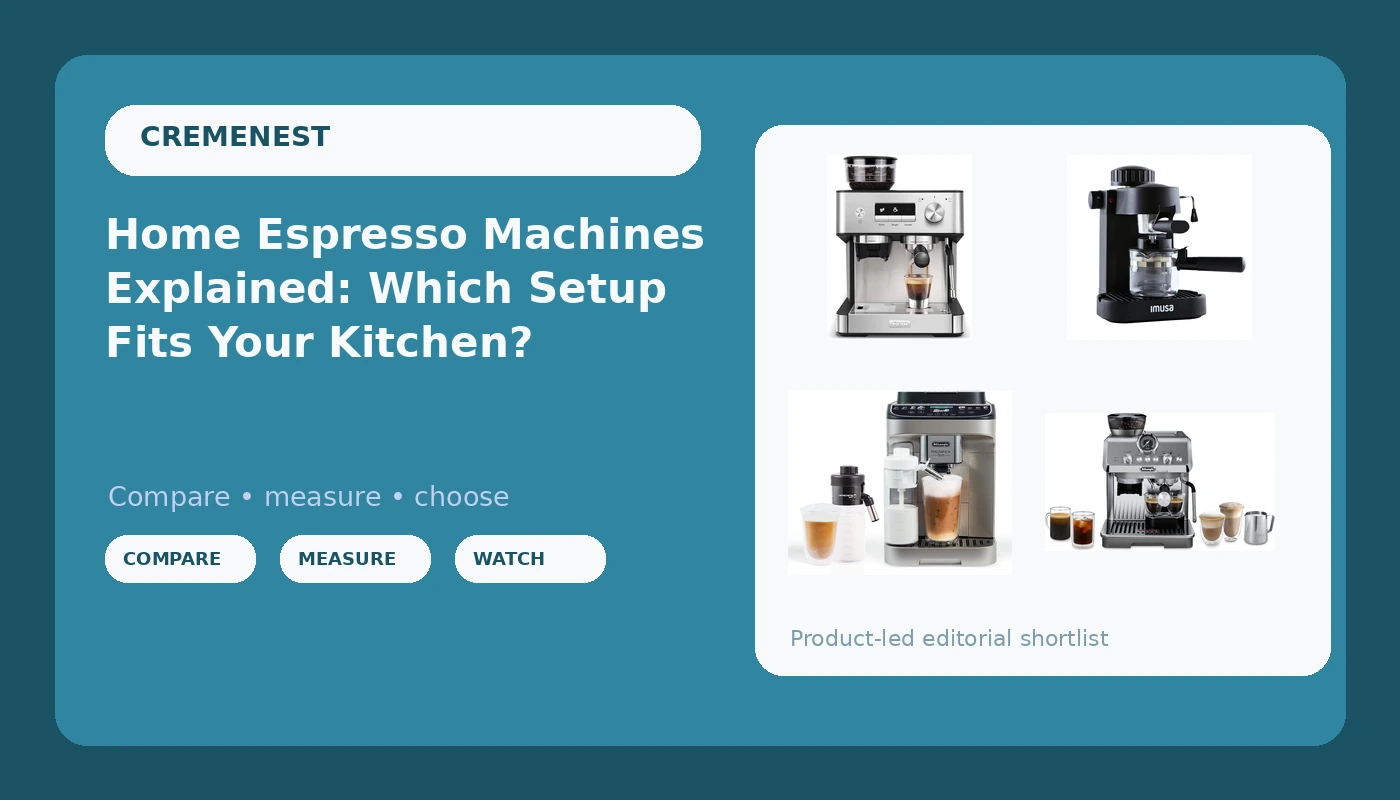
There is no single machine that suits everyone, because the deciding factor is how much of the process you want to handle yourself. If you want a grinder and a steam wand built into one unit without moving into four figures, the Gevi 20 Bar Espresso Machine with Grinder & Steam Wand is the practical starting point. If you want the smallest spend and a small footprint, the IMUSA 4 Cup Electric Espresso Cappuccino Coffee Maker covers that. If you want to learn to dial in a shot with your hands on the grinder and the tamper, the De'Longhi La Specialista Arte Evo is built for exactly that. And if you want a machine that handles grinding, brewing, and milk for you, the De'Longhi Magnifica Duo is the automatic option here. Match the machine to the workflow you will actually keep, not the one you imagine on a Sunday morning.
Four useful options
| Model | Best fit | What stands out |
|---|---|---|
| Gevi 20 Bar Espresso Machine with Grinder & Steam Wand for Latte Cappuccino | A first all-in-one setup | Built-in grinder plus a steam wand for latte and cappuccino |
| IMUSA 4 Cup Electric Espresso Cappuccino Coffee Maker, Black | Small kitchens and small budgets | Four-cup electric brewer in a compact black body |
| De'Longhi La Specialista Arte Evo Espresso Machine with Coffee Grinder | Learning to dial in by hand | Semi-automatic control paired with a built-in coffee grinder |
| De'Longhi Magnifica Duo Automatic Espresso Machine, Milk Frother, Silver | Hands-off daily coffee | Automatic brewing with an integrated milk frother |
The all-in-one starter: Gevi 20 Bar Espresso Machine with Grinder & Steam Wand for Latte Cappuccino
The trade-off with any built-in grinder is adjustability. A dedicated burr grinder usually gives you a wider range of settings and a more repeatable step between them, which matters when you are chasing a shot that runs a few seconds long or short. That said, the Gevi removes the two biggest barriers for a first setup: the cost of a second appliance and the counter space a second appliance eats. The 20 bar figure describes the pump's rated output, not the pressure the coffee sees at the puck; most espresso is extracted well below that. Read it as a pump specification, not a flavor promise.
The smallest spend: IMUSA 4 Cup Electric Espresso Cappuccino Coffee Maker, Black
Be clear about what this machine is. It is not a pump-driven espresso machine with a portafilter, a pressure gauge, and a group head you can tune. It brews a small volume of strong coffee that works as the base for a cappuccino, and it does so with almost no technique required. The grinder is not included, so the coffee you feed it sets your ceiling: pre-ground from a supermarket will taste like pre-ground from a supermarket. If your honest goal is a fast, cheap, small cup on a weekday and you have no interest in dialing in a shot, this is a legitimate answer. If your goal is to learn espresso, it is not the machine that will teach you.
The learning machine: De'Longhi La Specialista Arte Evo Espresso Machine with Coffee Grinder
This is the tier where the hobby starts. You are responsible for grind size, dose, distribution, and tamp, and every one of those variables shows up in the cup. That is the appeal and the cost. Some mornings you will nail it, and some mornings you will pour a sour shot down the sink and start over, and that is normal rather than a defect. The built-in grinder means you are not buying two machines, but it also means you are working within the adjustment range De'Longhi designed. If you already know you want to swap burrs and chase grinders later, buy the machine and the grinder separately instead.
The automatic: De'Longhi Magnifica Duo Automatic Espresso Machine, Milk Frother, Silver
Automatics trade control for consistency and speed. You give up the ability to change one variable at a time, because the machine has already made most of those decisions for you. In exchange, the fourth cup on a busy morning tastes like the first, and nobody in the house needs a lesson to use it. This is the right answer for a household where the espresso drinker is not the only person making coffee, or for someone who has already done the manual thing and is tired of it. It is the wrong answer for anyone who enjoys the ritual itself.
Prices and availability may change. Product images, names, and retailer links are matched to verified listings. No current price, rating, stock status, or measured result is stated here without current evidence.
The four styles, and what each asks of you
Think of home espresso as four levels of involvement rather than four price points. At the lowest level sits a small electric brewer like the IMUSA, which asks nothing of you and gives you strong coffee for milk drinks. Above it sits the all-in-one with a grinder, the Gevi, which asks you to learn basic technique but supplies the equipment. Above that sits the semi-automatic with a grinder, the La Specialista Arte Evo, which asks you to learn technique and pay attention to it. At the top of the involvement scale in reverse sits the super-automatic, the Magnifica Duo, which asks you to fill a hopper and a water tank and press a button.
The mistake is assuming the most expensive tier is the one you want. It is the one that fits the person. Someone who loves the ritual will find an automatic boring within a month. Someone who wants caffeine before a commute will find a semi-automatic to be a chore by week two. Neither of them is wrong, and neither machine is bad.
The specs that actually change the cup
Manufacturers lead with numbers that photograph well. Pressure ratings sell machines, but the pressure at the pump is not the pressure at the coffee, and nearly every machine in this class can reach adequate extraction pressure. What separates a good shot from a mediocre one is consistency: how steady the brew water temperature stays across the shot, how fine and how evenly the grinder can grind, and how fresh the beans are.
Two more practical points. First, the grinder matters more than the machine at almost every budget, which is why a built-in grinder is such a large part of what you are paying for in the Gevi and the La Specialista Arte Evo. Second, water is an ingredient. If your tap water is hard, you will be descaling far more often than the manual suggests, and the machine will not last as long. Filtered water is not a luxury here.
Five steps to decide:
- Write down who will use the machine and at what hour of the day.
- Decide honestly whether you want to grind, dose, and tamp, or press one button.
- Measure the counter space you have, including clearance for a hopper and a milk pitcher.
- Set a total budget that includes beans, a scale, and cleaning supplies, not just the machine.
- Pick the tier that matches your answers, then stop shopping.
What to check before you buy
- Confirm whether a grinder is included, because that single detail changes the total cost more than anything else.
- Check that the steam wand or frother suits the milk drinks you actually order, not the ones you order on vacation.
- Read the descaling and cleaning routine in the manual before buying, not after the first warning light.
- Make sure replacement parts and filters are available for the model you choose.
- Buy fresh whole beans dated recently; a great machine cannot rescue stale coffee.
Which option should you choose?
Choose the Gevi 20 Bar Espresso Machine with Grinder & Steam Wand for Latte Cappuccino when you want one machine that grinds, brews, and steams, and you are ready to learn a basic routine. Choose the IMUSA 4 Cup Electric Espresso Cappuccino Coffee Maker, Black when the budget and the counter are both tight and you want strong coffee with no technique. Choose the De'Longhi La Specialista Arte Evo Espresso Machine with Coffee Grinder when you want to learn the craft and intend to stay with it. Choose the De'Longhi Magnifica Duo Automatic Espresso Machine, Milk Frother, Silver when convenience and consistency matter more than control.
A caveat worth stating plainly: the descriptions above are drawn from the manufacturers' own product information, not from laboratory measurement, and no machine here has been presented as the quietest, the fastest, or the outright best. Any of these can make a good drink with fresh beans and reasonable water, and any of them can make a bad one with stale coffee.
The bottom line
The right home espresso machine is the one whose workflow you will still be willing to run on a bad morning three months from now. If you want the shortest path to a real shot with milk, the Gevi covers grinding, brewing, and steaming in one unit. If you want the cheapest possible route to a strong cup, the IMUSA does that and nothing more. If you want to learn, the La Specialista Arte Evo hands you the controls. If you want the machine to handle it, the Magnifica Duo does. Decide which of those four people you are, and the shopping gets short.