Most people buy the machine first and figure out the workflow later. They read spec sheets, watch a video of a latte being poured, and order something shiny. Three weeks after it lands, the machine is holding up a stack of cookbooks.
I have watched that happen more times than I can count. Twelve years behind a bar in Seattle and a few more setting up home espresso stations for friends, family, and two small cafes taught me one thing: a home espresso machine setup is a sequence, not a purchase. Water first, grinder second, machine third, routine last. Get the order wrong and you will spend real money making coffee that tastes worse than the drip pot you replaced.
This guide walks the whole sequence using two machines that cover the two most common kitchens I get asked about: the small counter and the busy morning. One is a compact manual machine that asks you to learn something. The other is an automatic that asks you to press a button. Both can make excellent coffee. They just ask different things of you.
Why you should trust me
I pulled shots professionally for 12 years and managed a third-wave coffee bar before I moved into home espresso consulting. There is a machine graveyard in my garage: the Breville that leaked, the Gaggia I modded into something unrecognizable, the ECM that is still going. I have set up stations on galley kitchens and on counters the size of a cutting board.
My bias is out in the open. The grinder is roughly 70% of the shot. A mid-priced machine with a serious grinder beats an expensive machine with a cheap one every time. I also refuse to recommend a machine without talking about the workflow around it, because the workflow is what you live with at 6:40 on a Tuesday morning, not the spec sheet.
How I picked and how I judged them
A spec sheet will not tell you how a machine feels on day 40. Five things do, and they sort machines fast.
Temperature stability. How steady the brew water stays across a shot. This is the difference between consistent espresso and coffee that is sometimes great and sometimes sour. It is the feature you feel on every shot.
The basket. Pressurized baskets marketed as a feature are a crutch. They hide stale beans and a bad grind, and they keep you from learning what your coffee can do.
The steam wand. If it cannot texture milk into proper microfoam, the machine has a ceiling. I do not care what the box calls it.
Dead time. The wait between pulling a shot and steaming milk on a single boiler. That wait is where a morning routine dies.
Footprint and upkeep. A machine that needs descaling every two weeks is a design failure, and a machine that does not fit your counter is furniture.
The two machines below answer the two questions I hear most: "I have no counter space" and "I do not want a hobby, I want coffee."
The two machines that anchor this setup
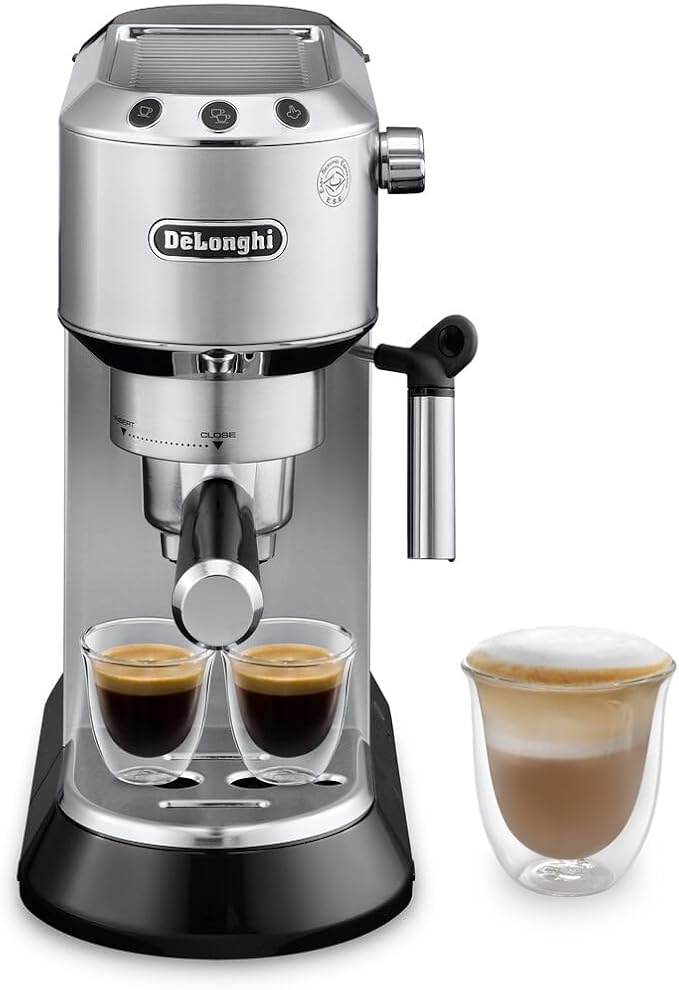
Budget pick: De'Longhi Dedica Espresso Machine, 15-Bar Pump, Frother, Stainless Steel
 Visit on Amazon →
This is the machine I point at when someone sends me a photo of a counter that is basically a sliver between the sink and a wall. It is narrow, it is stainless, and it does not ask for much room. Check current Amazon price.
It is a compromise, but a smart one. You are trading boiler capacity and steam power for a footprint that fits a rental kitchen, and for a lot of people that trade is correct. Machines in this size class usually ship with a pressurized basket as the default, and swapping to a standard basket plus a burr grinder is the single upgrade that changes the cup most. Budget for the grinder. If you cannot afford both at once, buy the grinder first and use a press pot until you can afford the machine.
Flaws but not dealbreakers: The steam wand on a compact machine takes practice, and the milk window is narrow. Expect a few weeks of mediocre foam before it clicks. The water tank is small, so refill it as part of your morning instead of letting it surprise you mid-shot.
This is for the small-counter household, the apartment, the person making one or two drinks a day who is willing to learn a manual workflow. If you want a machine that rewards attention without demanding a second counter, start here.
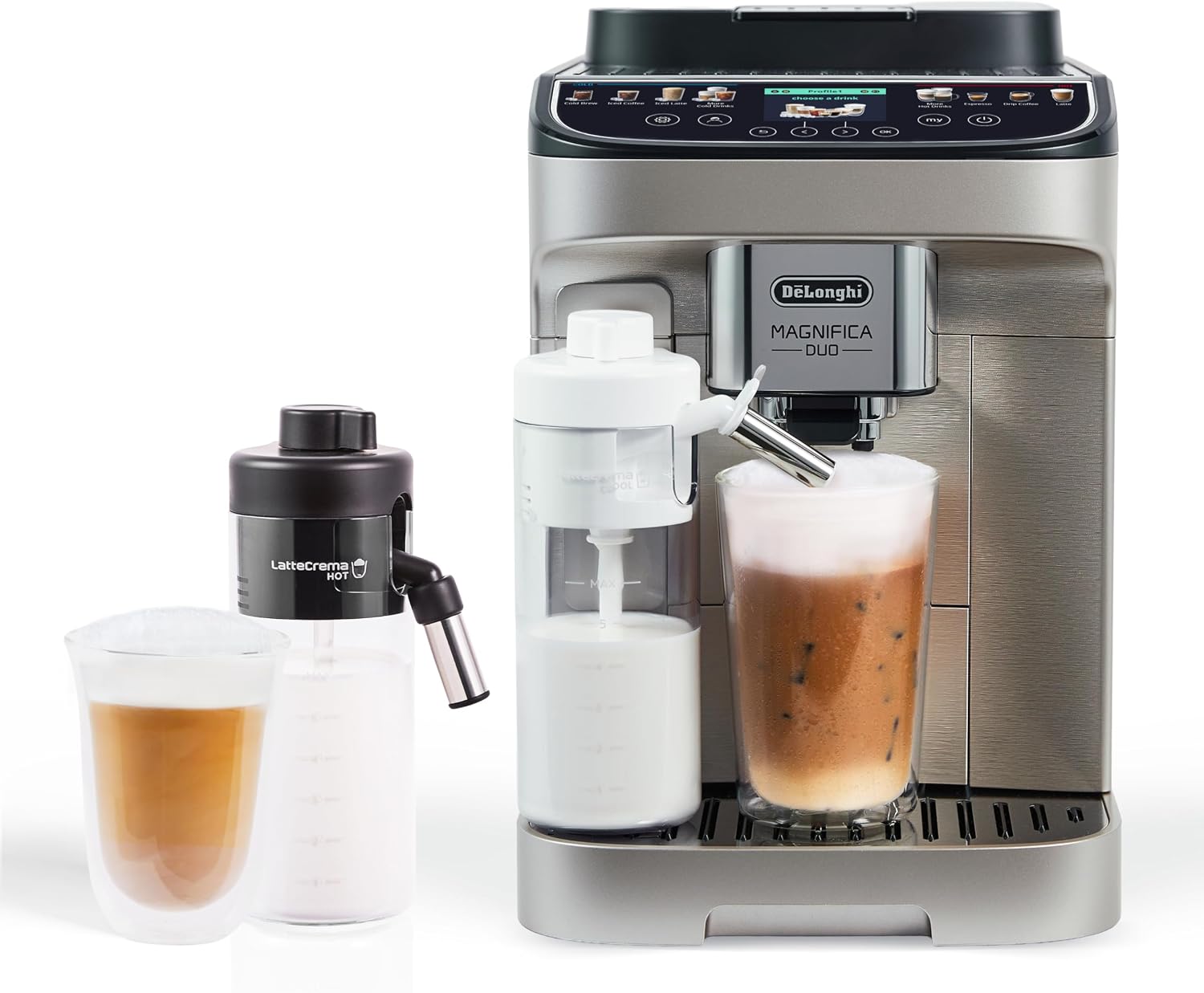
Upgrade pick: De'Longhi Magnifica Duo Automatic Espresso Machine, Milk Frother, Silver
 Visit on Amazon →
This is the answer for the household where two people leave at 7 and nobody wants to weigh beans at 6:45. It grinds, doses, and brews as one automatic workflow, and the built-in milk frother means you are not standing there with a pitcher and a stopwatch. Check current Amazon price.
The trade is control. An automatic makes the dosing decisions for you, so you give up some of the fine adjustment a manual machine offers, and you spend your energy on bean choice and grind setting instead of distribution technique. For a lot of homes that is a feature, not a loss. The workflow is short, repeatable, and survives a bad night of sleep.
Flaws but not dealbreakers: Automatics have more parts to clean and a bean hopper that rewards fresh beans. Stale beans in a hopper taste worse than stale beans in a bag, because you smell them every morning. Empty and refill weekly, and run the cleaning cycle when the machine asks rather than when the coffee tastes off.
This is for the busy household, the person who wants a flat white before the school run, and anyone who has already admitted they will not weigh beans at dawn.
The actual setup workflow
Now the part that matters more than either machine. This works on any machine you own or buy, manual or automatic.
Step one: Fix your water. This is the step everyone skips. If your tap water tastes like a swimming pool or leaves scale in the kettle, it will do the same inside your machine. Use filtered water, or a low-mineral bottled water you actually like the taste of. Water is most of the cup, and bad water makes every other step pointless.
Step two: Dial in the grinder before you touch the machine. Grind a small amount, look at it, then pull a shot and taste it. If the shot runs fast and tastes sour and thin, grind finer. If it chokes the machine and tastes bitter and dry, grind coarser. Change one variable at a time, and change the grind before you change anything else.
Step three: Buy fresh beans. Look for a roast date, not a best-by date. Beans within a few weeks of roasting behave predictably. Beans from a supermarket shelf behave like a lottery.
Step four: Dose, level, tamp. Weigh the coffee if your grinder allows it, level the bed, and tamp flat. A level puck with an even tamp beats a hard tamp with a tilted one. This is the step where beginners fight the machine instead of the puck.
Step five: Treat the first shot as a diagnostic. Taste it before you add milk. Ask two questions: is it sour or bitter, and is it thin or heavy. Then adjust the grind one notch and pull another. Two or three shots gets you to a drinkable cup, and a week gets you to a good one.
Step six: Purge the wand before you steam. Water left in the wand turns milk watery. Open the valve for a second, then steam. Aim for a whirlpool, not a scream. Stop when the pitcher is too hot to hold comfortably.
Step seven: Build the routine around the machine. Knock box, towel, cup, and grinder within arm's reach. If your setup requires walking across the kitchen mid-shot, you will stop using it. The best espresso station is a small one that works in a single motion.
Step eight: Clean on a schedule. Rinse the basket after every session, purge the wand, and descale on the interval your water demands. If you use filtered water, that interval gets longer. Most "my machine broke" stories are scale stories.
The competition and why it lost
There are machines I recommend constantly that are not in this guide, because they answer a different question.
The Breville Barista Express is the best all-rounder for beginners in my book. The built-in grinder is mediocre but workable, and the learning curve is gentle. It is not here because it takes up more counter than the two above and bundles a grinder you will eventually want to replace.
The Gaggia Classic Pro is the budget modder's dream. A small over-pressure valve spring swap transforms the shot, but the stock steam wand is weak, and a modder's machine is the wrong first machine for someone who wants coffee before work.
The Rancilio Silvia is the best first serious machine. It is bombproof and parts exist forever, but the single boiler means real dead time between the shot and the milk.
The ECM Synchronika is the endgame. Dual boiler, rotary pump, temperature stability you can set your watch to. It is also the machine you buy after you have outgrown the hobby stage, not before.
The short version: buy the workflow you will actually keep, not the one you imagine on a Sunday morning with no alarm.
What this all costs
I am not going to quote prices here, because they move and you should check the live number on the listing. Check current Amazon price on both machines above and do the math from there.
What I will give you is the allocation. Split your budget so the grinder gets a serious share. A machine with a mediocre grinder makes mediocre coffee, and a good grinder follows you to the next machine. If the two machines here sit at very different points on the price ladder, that gap is mostly convenience and automation, not cup quality. A compact manual machine plus a real burr grinder can beat an automatic with a weak grinder, and an automatic with fresh beans beats a manual with stale ones.
Spread over five years of daily use, the difference between these two paths is pennies a day. The difference between either path and a blade grinder is the difference between espresso and disappointment.
The bottom line
Start with water and a grinder. Pick the machine that matches the counter and the morning you actually have, whether that is a narrow manual machine you learn on or an automatic that does the work while you find your shoes. Then run the eight steps until they are boring, because boring is the goal. The shot you can repeat tomorrow is worth more than the one you nailed once.
That is the whole job. The machine is the last decision, not the first one.