Scale is the quiet killer of home espresso. It does not announce itself with a bang. It builds up in the boiler, on the heating element, inside the steam wand, and behind the shower screen, one thin layer at a time, until your shots taste flat and sour and your pump starts sounding like it is working uphill. By the time most people ask me about it, the machine has been running restricted for months.
Here is the short version of how to descale an espresso machine: use a real descaler on a schedule, run it through every water path in the machine, then rinse until the water coming out tastes like nothing at all. That is the whole job. The detail is in the order you do it and in how seriously you take the rinse.
I have pulled something north of 40,000 shots in twelve years, most of them behind a third wave bar, and the rest on other people's counters. Seattle water is soft enough that I could get lazy about this. I do not, because a machine that sits with water in it will scale no matter what the water report says.
Why you should trust me
I spent twelve years as a barista and managed a third wave coffee bar before I moved into home espresso consulting. I have set up stations for friends, for family, and for two cafes, and I have a machine graveyard in my garage to show for it: the Breville that leaked, the Gaggia I modded into something unrecognizable, the ECM that is still going. Almost none of those failures were electronic. They were water.
I do not recommend a machine I have not spent real time with, and I do not hand out a maintenance routine I would not run on my own counter. What follows is the descaling routine I actually use, plus the two things I would buy first if I were starting a home setup from zero today.
How I picked the two things you need
Descaling is a two part problem. You need a machine worth maintaining, and you need a descaler that is labeled for the parts inside that machine. I looked for a few specific things.
On the descaler side, I want a product that names boilers and heating elements on the label, not just coffee pots and kettles. Citric acid based powders are the standard for a reason: they dissolve scale, they rinse clean, and they do not leave the machine smelling like a salad dressing experiment.
On the machine side, I want a removable water reservoir, a steam wand you can actually purge and clean, and a group head you can get a brush into. I also want the grinder question answered in one purchase if the buyer is new, because a bad grinder will make good coffee taste broken no matter how clean the boiler is. These are selection criteria, not lab results. Judge them the way I do, by whether the workflow survives month three.
The kit: two things on the counter
You do not need a shelf of chemicals. You need the machine and the descaler, and a pitcher of clean water for rinsing.
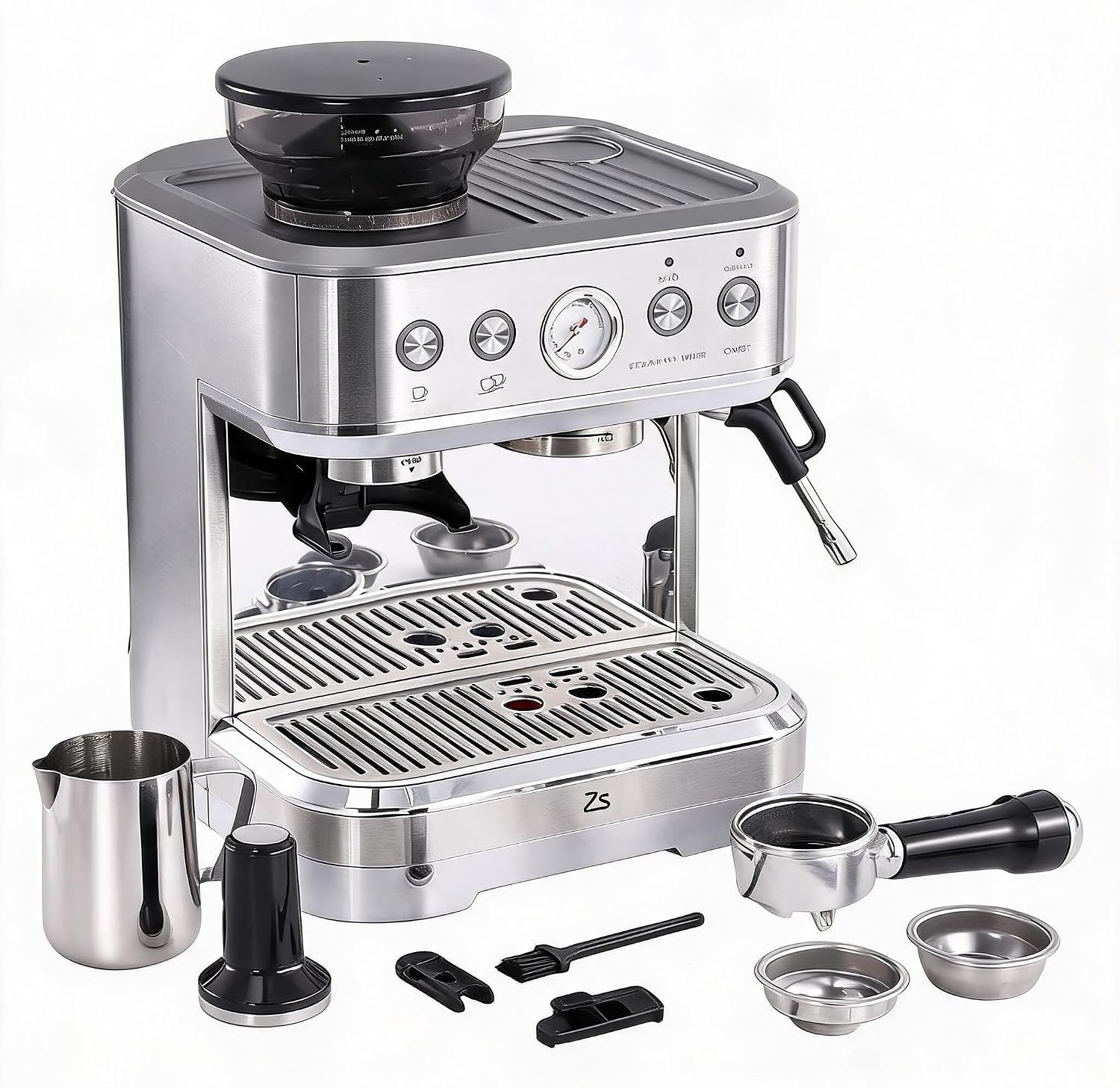
The machine: 15 Bar Espresso Machine with Grinder Multi-Function Coffee Maker Machine
 Visit on Amazon →
This is the one box answer for someone who wants espresso at home without buying a machine and a grinder as two separate projects. It pairs a 15 bar pump with a built in grinder and a multi function layout, which means you grind, dose, tamp, and pull without leaving the counter.
The 15 bar number is the spec people ask about and the one that matters least once you are dialed in. What matters is that the machine has a water reservoir you can pull off and rinse, a steam wand you can purge after every milk drink, and a group area you can brush out weekly. Every one of those access points is a place scale collects, and every one of them is a place this routine needs to reach.
If you are the kind of person who wants to buy a machine, learn the workflow, and only then decide whether this hobby is for you, this is the sane starting point. If you already own a grinder you love, spend your money there instead. A great grinder on a modest machine beats the reverse every single time.
Flaws but not dealbreakers: A built in grinder in this class is a compromise. It will do the job, but it is not the last grinder you will ever want, and the burrs will not give you the fine adjustment a standalone unit does. Treat it as a starting point, not a destination.
Anyone building a first station, or buying for a kitchen where one appliance has to do several jobs, will get along with this one fine.
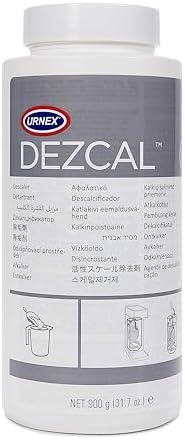
The descaler: Urnex Dezcal Coffee and Espresso Machine Descaler Activated Scale Remover - 900g Bottle - Fast Effective Descaling Of Boilers and Heating Elements Faucets Spray Heads Milk Systems
 Visit on Amazon →
This is the descaler I keep on my own shelf. The label names the parts I care about: boilers, heating elements, faucets, spray heads, and milk systems. That list matters, because a descaler that only claims to clean a kettle is not a product I want running through a machine with a heating element inside it.
The 900g bottle is the other reason I keep it. You mix what you need per descaling session, use it, and the rest of the bottle waits for the next round. It also means one purchase covers the espresso machine, the kettle, and the spray head on the sink, which is more useful than it sounds.
Do not use vinegar because it is in the cabinet. Vinegar works on scale, but it stinks, it is hard to fully rinse out of a sealed water path, and it is not what the manufacturer of your machine wrote into the manual. Check current Amazon price, then check what your machine's manual says about descaling products, and buy accordingly.
Flaws but not dealbreakers: It is a powder, so you have to mix it and you have to store the bottle somewhere dry. That is the entire complaint list.
Anyone with hard water, a machine that has never been descaled, or a kettle with a chalky bottom should own this.
The descaling workflow, step by step
This is the routine. It works on a single boiler, a thermoblock, or a heat exchanger machine. If your manual contradicts anything below, the manual wins.
Step one: read the manual and clear the counter. Find the descaling section before you open the bottle. Some manufacturers specify their own solution, and some warn against acidic descalers on certain boilers. Two minutes here saves a machine.
Step two: strip the machine down. Pull the water reservoir, the drip tray, the portafilter, and the basket. If you have a blind basket for backflushing, set it aside for later. Empty the reservoir completely.
Step three: mix the solution to the ratio on the label. Do not free pour. A stronger mix does not descale faster, it just gives you more to rinse out of a sealed system. Fill the reservoir with the mixed solution.
Step four: run it through the group head in cycles. Turn the machine on and let it come to temperature. Then run the solution through the group in short bursts, maybe ten seconds on, ten seconds off, until you have pushed roughly half the reservoir through. The cycling is what lets the solution sit on the scale instead of just washing past it.
Step five: do the steam wand. This is the step everyone skips and the one that fixes the most complaints. Steam wands clog from the inside out. Open the steam valve and let the solution run through the wand in bursts until the flow looks even and strong. If your machine has a hot water spout, run solution through that too.
Step six: let it dwell. Turn the machine off and let the solution sit in the boiler and lines for the dwell time on the label. Longer is not better. Leaving acidic solution in a machine overnight is how people damage seals and finishes.
Step seven: rinse like you mean it. Empty the reservoir, fill it with clean water, and run the entire reservoir through the group head and the steam wand. Then do it again. Then do a third pass with the machine hot. You are rinsing until the water tastes like water. If it tastes like lemon, keep going.
Step eight: pull a throwaway shot. Reassemble everything, refill with fresh water, and pull one shot straight into the drip tray. Dump it. Then pull the shot you actually want to drink, and notice whether the flow is faster and the taste is cleaner than it was an hour ago. If you have a blind basket and a backflush routine, run it now with plain water, not descaler.
How often you actually need to descale
The honest answer is that it depends on your water, and nobody can give you a calendar date from across the internet. Hard water and four shots a day can mean every four to eight weeks. Soft water and two shots a day can stretch to three or four months.
Watch for the signs instead of trusting the calendar. The steam wand starts sputtering or losing pressure. The pump gets louder and the flow gets slower. The machine takes longer to come up to temperature, or the temperature wanders shot to shot. The espresso tastes flat, chalky, or sour even when your grind and beans have not changed. Any one of those is a descaling signal.
If your machine seems to need descaling every two weeks, the problem is the water, not the machine. Filter it. A simple carbon filter or a pitcher filter will cut the scale load dramatically, and it is the cheapest upgrade in this whole hobby. I care more about what goes into the reservoir than almost any other part of the setup, because water is most of what ends up in the cup.
Mistakes that kill machines
Vinegar on aluminum. Acidic descalers and aluminum boilers are a bad combination, which is why step one is reading the manual.
Descaling a hot machine with a cold solution. Thermal shock is real, especially on boiler fittings. Let the machine cool to warm before you start.
Leaving the solution in overnight. There is no scale that requires an overnight soak and there are several seals that will not enjoy one.
Skipping the steam wand and hot water spout. Half the scale in a home machine lives in the paths people forget.
Not rinsing enough. Descaler residue tastes terrible and it is the number one reason someone tells me their machine "tastes weird after cleaning."
What this all costs
There is no exotic chemistry here. You are buying a machine and a bottle of descaler. Check current Amazon price on the descaler and you will find it costs less than most bags of specialty beans, and the bottle covers many sessions. Check current Amazon price on the machine and you are looking at a one time purchase that replaces both a grinder and an espresso maker.
The real cost is the twenty minutes you spend four times a year doing this properly, and the cost of skipping it, which is a machine in my garage graveyard.
The bottom line
Your machine is not fragile. It is a pump, a heating element, and a set of water paths, and all three of them hate scale. Descale on a schedule that matches your water, rinse until the water tastes like nothing, and purge the steam wand every time you use it. Do that and the machine you bought this year will still be pulling shots when you have forgotten what you paid for it.
That is the job. The espresso is on the other side of a clean boiler.