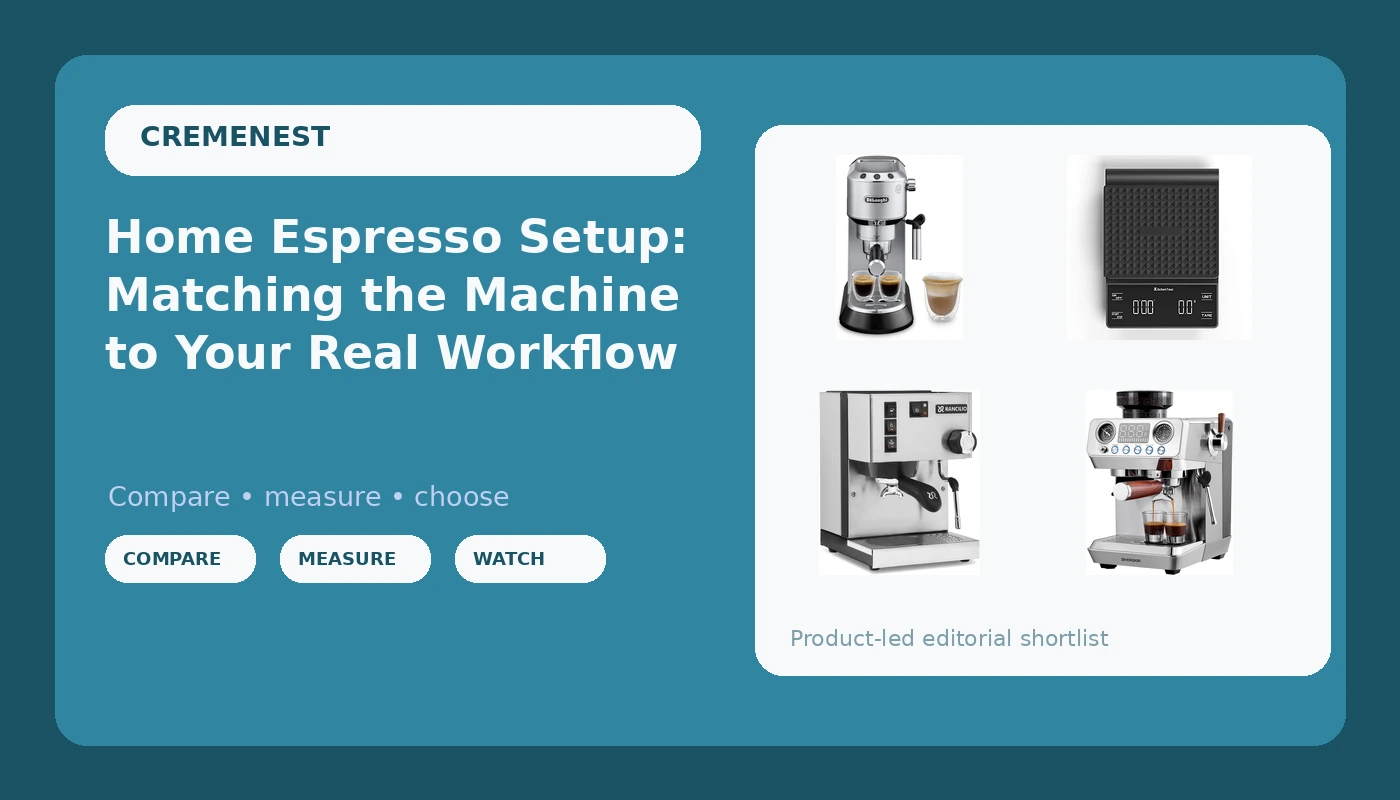
Most home espresso setup advice starts with the machine, which is backwards. The machine is one part of a system: grinder, dose, basket, scale, and the counter space you are willing to hand over. Get the order wrong and you end up with a four-figure machine pulling thin, sour shots next to a bargain blade grinder, or a beautiful stainless box that never gets used because the milk pitcher does not fit under the steam wand. The four products here cover the realistic range for a home kitchen: an all-in-one machine with a built-in grinder, a narrow machine for tight counters, a stainless workhorse for people who want to buy once, and a precision scale that quietly fixes more bad shots than any upgrade. The question is not which one looks strongest on a spec sheet. It is which one you will still be glad to use on a Tuesday morning three months from now.
Related: Espresso Grinder Basics: Why Burr Geometry Beats Bar Count →
Quick answer
Match the machine to your counter, your milk habit, and whether you already own a grinder. The SHARDOR 20 Bar Espresso Machine with Built-In Grinder handles grinding and brewing in one body, which is the simplest way into a first home espresso setup. The De'Longhi Dedica is the pick when the kitchen, not the coffee, sets the size limit. The Rancilio Silvia is the stainless steel machine for someone who wants one purchase to last a decade. The KitchenTour Coffee Scale with Timer belongs in all three setups, because weighing the dose and the shot is the least expensive way to make any machine more consistent.
Four useful options
| Model | Best fit | What stands out |
|---|---|---|
| SHARDOR 20 Bar Espresso Machine with Built-In Grinder, Stainless Steel | A first setup with one plug and one footprint | 20 bar pump and a built-in grinder in a stainless steel body |
| De'Longhi Dedica Espresso Machine, 15-Bar Pump, Frother, Stainless Steel | Small kitchens and milk drinks | 15 bar pump and a built-in frother in a slim stainless body |
| Rancilio Silvia Espresso Machine, Stainless Steel | A machine you keep and service for years | Stainless steel construction in the single boiler class |
| KitchenTour Coffee Scale with Timer 3kg/0.1g High Precision Pour Over Drip Espresso Scale with Back-Lit LCD Display (Batteries Included) | Anyone who wants repeatable shots | 3 kg capacity, 0.1 g resolution, built-in timer, back-lit LCD |
All-in-one starter: SHARDOR 20 Bar Espresso Machine with Built-In Grinder, Stainless Steel
The appeal here is arithmetic. A separate grinder and machine means two purchases, two footprints, and two learning curves at once. A built-in grinder collapses that into one decision. The trade-off is that built-in grinders in this class are the first part you will outgrow. They typically offer fewer grind settings and less adjustment range than a standalone burr grinder, so a bean that needs a very fine setting may sit at the edge of what the dial can do. That is not a reason to avoid the machine. It is a reason to plan for it. Buy this one, learn the workflow on it, and treat a standalone grinder as your second purchase rather than your first. If the machine arrives and the shots run fast and sour no matter what you do, the grind is the first variable to chase, not the pressure.
Small-counter pick: De'Longhi Dedica Espresso Machine, 15-Bar Pump, Frother, Stainless Steel
This is a compromise machine, and the honest framing is that you should know which compromises you are accepting. The frother is convenient and produces textured milk without a steep steaming learning curve, but a frother and a proper steam wand are not the same tool, and the difference shows in the texture of the milk rather than in the speed. The smaller basket size that comes with a slim machine also means a thinner puck, which is less forgiving of a sloppy distribution. Where this machine wins is in the constraint that actually matters to a lot of people: a small kitchen that will never host a full-size setup. A machine you use every morning beats a better machine that lives in a cupboard.
Buy-once machine: Rancilio Silvia Espresso Machine, Stainless Steel
This is the step up that changes what you can learn, not just what you can drink. A machine in this class rewards a good grinder and punishes a bad one, which is the whole argument for buying the grinder first. The single boiler is the trade-off to understand before you order: you brew, then you wait for the boiler to come up to steaming temperature, then you steam. For one flat white that wait is nothing. For four milk drinks in a row it is a genuine interruption, and no amount of technique removes it. If your mornings are two espressos and out the door, this class of machine is close to ideal. If your mornings are a round of lattes for a family, budget for a machine with a separate steam source instead.
Prices and availability may change. Product images, names, and retailer links must be matched by verified ASIN. Do not state a current price, rating, stock status, or measured result without current evidence.
The accessory: KitchenTour Coffee Scale with Timer 3kg/0.1g High Precision Pour Over Drip Espresso Scale with Back-Lit LCD Display (Batteries Included)
A scale is the least glamorous item in a home espresso setup and the one that changes the most. Without one, you are dosing by eye and by volume, which means the dose drifts a gram or two every morning and the shot drifts with it. With one, you can hold the dose steady and weigh the output as it lands in the cup, which turns a vague "that tasted off" into a number you can adjust. The built-in timer matters for the same reason: shot length is one of the few variables you can measure without tasting anything. A 3 kg capacity with 0.1 g resolution covers espresso doses, pour over, and the occasional batch brew without needing a second device, and the back-lit display helps in a kitchen where the machine sits under a cabinet.
Why the scale changes more shots than the machine
Espresso is a ratio problem before it is a machine problem. A dose of ground coffee, a yield of liquid in the cup, and a time. Change any one of them and the taste moves. The reason a scale outperforms a machine upgrade for most people is that it lets you hold two of those three constant while you change the third on purpose.
Consider what happens without one. You fill the basket by eye, tamp, and press go. Some mornings the basket holds a little more coffee, so the water finds more resistance, so the shot runs long and tastes bitter. Other mornings it holds less, the water runs through fast, and the shot tastes sour and thin. You blame the beans, then the machine, then yourself. In reality the dose moved and nothing else did.
Weighing the dose and the yield fixes the diagnosis problem. If the shot ran fast and sour at the same dose and the same yield, the grind is too coarse. If it ran slow and bitter at the same dose and yield, the grind is too fine. Without a scale you cannot tell those two apart reliably, because you cannot tell whether the dose changed. This is also why a scale belongs in the budget before a second machine does. It is the tool that makes every other purchase more useful, and it is the only item on this list that helps with pour over and espresso both.
Reading the specs that actually matter
Bar pressure is the most advertised number and the least useful one. Machines in this range list 15 bar or 20 bar, and those figures describe the pump, not the pressure at the puck. What matters is whether the machine delivers a stable, sensible pressure at the group during the shot, and how steady the brew temperature stays across the whole extraction. Temperature stability is the spec you feel every single day. It is the difference between a machine that pulls consistently good shots and one that is sometimes great and sometimes sour with no change in your technique.
Basket size and basket type are the next two things to check. A pressurized basket is a crutch that produces something that looks like espresso regardless of the grind, which hides stale beans and a bad grinder rather than fixing them. A non-pressurized basket tells you the truth about your grind, which is unpleasant for a week and useful forever. Larger baskets give you a deeper puck, and a deeper puck is more forgiving of small distribution mistakes.
Finally, understand the boiler arrangement before you buy, because it determines your workflow more than any feature list. A single boiler brews and steams from the same source, so there is dead time between the two. A dual boiler or heat exchanger removes that wait. If you drink espresso, this is nearly irrelevant. If you make milk drinks for a household, it is the single biggest daily difference between one machine and another.
Five decisions to make before you buy
- Measure the counter, then measure the clearance under the upper cabinets. Height and depth rule out more machines than budget does.
- Count the milk drinks you actually make in a week, not the ones you imagine making. That count decides whether dead time between brew and steam matters.
- Decide whether you are buying a grinder now or later. If later, an all-in-one machine carries you until you are ready for a standalone grinder.
- Choose your basket philosophy. If you want convenience and forgiving results, a pressurized basket is a starting point. If you want to learn, plan for non-pressurized and expect a rough first week.
- Budget the accessories before the machine. A scale, a tamper that fits the basket, a milk pitcher, and a knock box are part of the setup, not extras you buy afterward.
Setting up the counter around the machine
- Put the scale where you can read it while the shot runs, not behind the machine.
- Keep the grinder and the machine on the same surface so you are not carrying a basket across the kitchen.
- Leave room to the right of the group head if you are right-handed, and to the left if you are not. Steam wand clearance matters more than it looks.
- Store beans in a container that fits your weekly volume. A hopper full of beans you will not finish in two weeks is a freshness problem.
- Clean the group and the basket daily with a flush, and plan a deeper clean on a schedule. Machines in this class do not fail from use nearly as often as they fail from neglect.
Which option should you choose?
Choose the SHARDOR 20 Bar Espresso Machine with Built-In Grinder, Stainless Steel when you want one purchase, one plug, and one footprint while you learn the workflow. Choose the De'Longhi Dedica Espresso Machine, 15-Bar Pump, Frother, Stainless Steel when counter space is the hard constraint and you want milk drinks without a steaming learning curve. Choose the Rancilio Silvia Espresso Machine, Stainless Steel when you already have or plan to buy a proper grinder and you would rather wait for steam than replace a machine in three years. Add the KitchenTour Coffee Scale with Timer 3kg/0.1g High Precision Pour Over Drip Espresso Scale with Back-Lit LCD Display (Batteries Included) regardless of which machine you pick, because it is the cheapest way to make any of them more repeatable.
One caveat on all of this: the fit depends on your kitchen and your habits, and those are things no spec sheet describes. A machine that suits a two-espresso household can be genuinely frustrating for a family making four lattes at once. Buy for the routine you already have, not the one you are hoping to develop.
The bottom line
The machine matters less than the system around it. A modest machine with a scale, a decent grinder, and fresh beans will outdrink an expensive machine fed by guesswork. If you are starting from nothing, the all-in-one machine plus the scale gets you brewing and measuring on day one. If your kitchen is tight, the compact machine is a deliberate compromise rather than a mistake. If you are past the beginner stage and want a machine that stays on your counter for years, the stainless steel single boiler is the honest answer, with the caveat that you will wait for steam. Whichever you choose, weigh your dose, weigh your yield, and change one variable at a time. That habit is worth more than any upgrade you can buy.