Most people build a home espresso setup in the wrong order. They choose the machine first, plug it in, and then spend a month wondering why the same beans taste thin on Monday and harsh on Friday. The machine is the part that gets photographed, but it is rarely the part that decides whether your coffee actually improves. What decides it is whether the station works as a system: something that holds brew temperature, a scale so you can repeat a recipe, and a cleaning habit you will keep past week two.
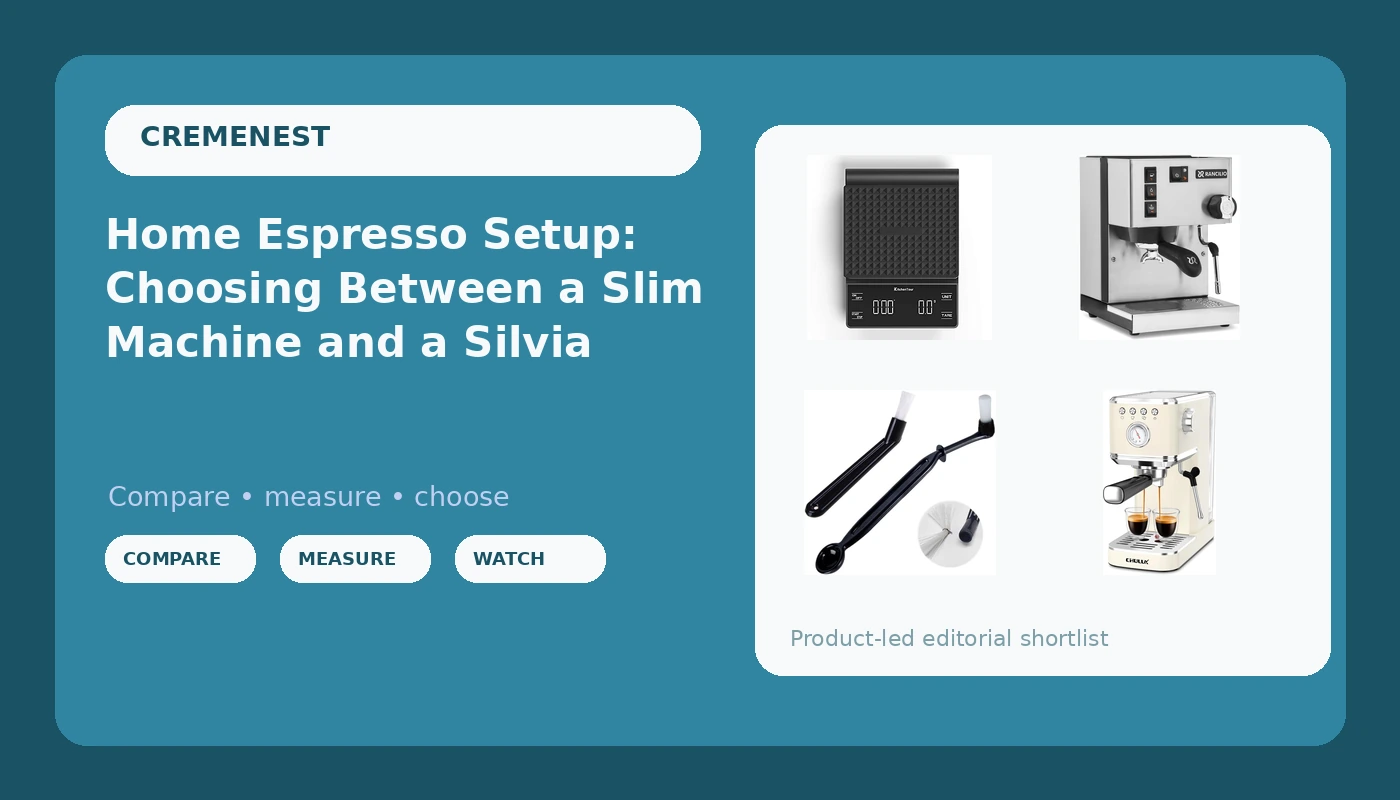
This guide covers four pieces that fill those roles at very different budgets. One is a stainless single boiler that people keep for years. One is a slim countertop machine with a milk frother. One is a precision scale. One is a brush set. Each can be bought on its own, and each solves a different part of the loop between grinding beans and wiping down the counter.
Related: How to Dial In Espresso at Home Without a Bottomless Portafilter →
Quick answer
Match the machine to your counter and your patience, then spend what is left on repeatability. The Rancilio Silvia suits someone who wants a stainless, serviceable machine and is willing to learn its workflow. The CHULUX Slim suits a small kitchen and a cappuccino habit. The KitchenTour scale suits anyone who would rather weigh doses and yields than guess at them. The cleaning brush set suits the person who wants the group head and grinder kept clean enough that yesterday's oils do not show up in today's shot. Prices and availability move, so confirm the current listing before you buy.
Four useful options
| Model | Best fit | What stands out |
|---|---|---|
| Rancilio Silvia Espresso Machine, Stainless Steel | A first serious machine you plan to keep | Stainless steel body and a design known for being serviced rather than replaced |
| CHULUX Slim Espresso Machine with Milk Frother for Home Cappuccino, Creamy | Small counters and milk drinks | Slim footprint with a built-in milk frother |
| KitchenTour Coffee Scale with Timer 3kg/0.1g High Precision Pour Over Drip Espresso Scale with Back-Lit LCD Display (Batteries Included) | Weighing dose, yield, and shot time | 3kg capacity, 0.1g resolution, built-in timer, back-lit LCD |
| Coffee Machine Cleaning Brush Set, 2 Pieces Espresso Cleaner Brushes with Spoon Tool - Group Head Brush,Small Nylon Stainless Steel Bristles Brush for Grinders Home Kitchen Accessories | Weekly group head and grinder upkeep | Two brushes plus a spoon tool |
The machine you keep: Rancilio Silvia Espresso Machine, Stainless Steel
The trade-off here is time, not money. A single boiler heats one body of water and uses it for both brewing and steaming, so milk drinks happen in two stages: pull the shot, then wait for the boiler to climb into steaming range before you texture anything. For a straight espresso drinker that wait never arrives. For someone making two flat whites before work, it is the difference between a five-minute routine and a ten-minute one, and it is worth deciding which of those you are before you spend the money.
The second trade-off is that a machine like this does not hide anything. There is no built-in grinder making your decisions and no pressurized basket smoothing over a coarse grind. That is the point of buying it, but it means the grinder becomes the real budget item. A capable burr grinder paired with this machine will out-drink a far more expensive machine paired with a blade grinder, and that math does not change no matter how many features the machine advertises.
The small-counter pick: CHULUX Slim Espresso Machine with Milk Frother for Home Cappuccino, Creamy
This is the category where expectations matter most. A compact machine with an integrated frother is not trying to pull the same shot as a stainless single boiler, and judging it that way misses what it is for. It is for the person with 12 inches of usable counter who wants a milk drink in the morning without a separate frothing pitcher, a separate steaming routine, and a separate cleanup.
Two things to keep in mind. First, compact machines often ship with a pressurized basket, which builds resistance artificially so that pre-ground coffee still produces something drinkable. That is genuinely useful if you are not grinding fresh yet, and genuinely limiting once you are, because it hides the feedback that teaches you to grind better. Second, milk texture is the hardest part of any home machine, and a built-in frother handles that job for you at the cost of some control. If you mostly drink cappuccino, that is a fair trade. If you mostly drink straight espresso, put the money toward a grinder instead.
The repeatability tool: KitchenTour Coffee Scale with Timer 3kg/0.1g High Precision Pour Over Drip Espresso Scale with Back-Lit LCD Display (Batteries Included)
A scale is the least glamorous purchase in this article and the one most likely to change your coffee within a week. Without one, you are dosing by scoop and stopping the shot by color, which means every variable in your routine is moving at once. With one, you can hold the dose steady at, say, 18 grams, hold the yield steady at 36 grams, and change exactly one thing at a time when the shot tastes off.
The 0.1g resolution matters more than it sounds. Espresso doses are small, so a scale that rounds to the nearest gram can swing your ratio by several percent between shots, and that is enough to taste. The built-in timer is the other half of the job: time is a symptom, not a target, but knowing whether a shot ran for 22 seconds or 38 seconds tells you whether to adjust the grind or your technique. Look for a platform wide enough to sit a portafilter and a cup without tipping, and keep it dry, because water and electronics do not negotiate.
The maintenance kit: Coffee Machine Cleaning Brush Set, 2 Pieces Espresso Cleaner Brushes with Spoon Tool - Group Head Brush,Small Nylon Stainless Steel Bristles Brush for Grinders Home Kitchen Accessories
Old coffee oil is the most common cause of a shot that tastes worse than it should for no visible reason. The group head collects a film of it, the basket holds it in the holes, and the grinder chute keeps a stale pinch of yesterday's grounds that ends up in today's dose. None of that shows up in a photo of the machine, and all of it shows up in the cup.
A brush set like this one is not a deep-clean solution on its own. Machines that support backflushing still need a blind basket and a cleaning powder for the internal path, and the grinder still benefits from a periodic burr cleaning. What the brushes do is handle the daily and weekly layer: knock the spent puck out, brush the group screen, scrub the basket under hot water, and clear the grinder chute. Do that consistently and the bigger cleaning jobs become rare instead of urgent.
Prices and availability may change. Product images, names, and retailer links must be matched by verified ASIN. Do not state a current price, rating, stock status, or measured result without current evidence.
What the machine actually controls
Espresso is hot water pushed through a packed bed of fine coffee at pressure. Almost every machine on the market does that. What separates them is how steady the water temperature stays, how much pressure the pump actually delivers at the puck, and how much of the workflow you have to do by hand.
Temperature stability is the one you feel every single day. If brew water drifts across a shot, you get a cup that tastes sour at the start and bitter at the end, or the reverse, and no amount of grinder tuning fixes it. Boiler design drives this: a single boiler has to recover between shots, a heat exchanger keeps brew water separate from steam, and a dual boiler holds both at once. More boilers mean more money and less waiting.
Pressure is the other variable. Many budget machines ship with an over-pressure valve set well above the 9 bar that espresso is typically brewed at, which makes the puck harder to manage and the shot harder to repeat. Some machines let you adjust that valve, and on a first serious machine it is one of the most useful modifications available. Portafilter size matters for the same reason: the professional standard is 58mm, and smaller baskets mean a thinner puck that is less forgiving of distribution mistakes.
None of this rescues bad coffee. Fresh beans, ground consistently, do more for the cup than any feature list.
Building a recipe you can repeat
- Weigh the dose into the basket with the scale set to grams, and write the number down.
- Distribute the grounds level, then tamp flat with steady pressure. Consistency beats force.
- Start the timer as the pump begins and watch the yield on the scale, not the clock alone.
- Stop the shot at your target yield, then taste it. Note the number and the flavor together.
- Change one variable at a time: grind finer or coarser first, then dose, then temperature.
Practical guidance for a real kitchen
- Measure your counter clearance and your cabinet overhang before ordering anything.
- Budget for a burr grinder before you upgrade the machine, every time.
- Use filtered water and descale on a schedule, because scale kills temperature stability.
- Purge and wipe the group after every session, not every weekend.
- Brush the basket and grinder chute weekly, and keep the brushes where you can see them.
Which option should you choose?
Choose the Rancilio Silvia Espresso Machine, Stainless Steel when you want a machine you can keep, service, and grow into, and you are ready to own the grinder decision separately. Choose the CHULUX Slim Espresso Machine with Milk Frother for Home Cappuccino, Creamy when counter space is the constraint and milk drinks are the habit. Choose the KitchenTour Coffee Scale with Timer 3kg/0.1g High Precision Pour Over Drip Espresso Scale with Back-Lit LCD Display (Batteries Included) when you want to stop guessing at dose and yield. Choose the Coffee Machine Cleaning Brush Set, 2 Pieces Espresso Cleaner Brushes with Spoon Tool - Group Head Brush,Small Nylon Stainless Steel Bristles Brush for Grinders Home Kitchen Accessories when you want the daily cleanup to take two minutes instead of twenty.
A scale and a brush set make sense next to any of these machines, so they are rarely an either-or decision. The real fork is between the two machines, and it comes down to counter space, milk volume, and whether you want a machine that asks you to learn.
The bottom line
A home espresso setup gets better in a predictable order: fresh beans, a consistent grind, a measured dose, a clean group, and only then a more expensive machine. The Rancilio Silvia is the long-term pick for someone who wants a stainless machine to learn on and keep. The CHULUX Slim is the practical pick for a small kitchen and a cappuccino routine. The KitchenTour scale and the cleaning brush set are the two small purchases that make whichever machine you choose behave like a better one. Check the current listing for each before you commit, since prices and availability change.