Most people build a home espresso machine setup backwards. They start with the machine, because the machine is the part with a badge on it, and then discover that what they bought cannot make the coffee they imagined. The grind is too coarse, the basket is pressurized, the milk never quite textures, and by week three the group head is coated in old oils that make every shot taste like the one before it.
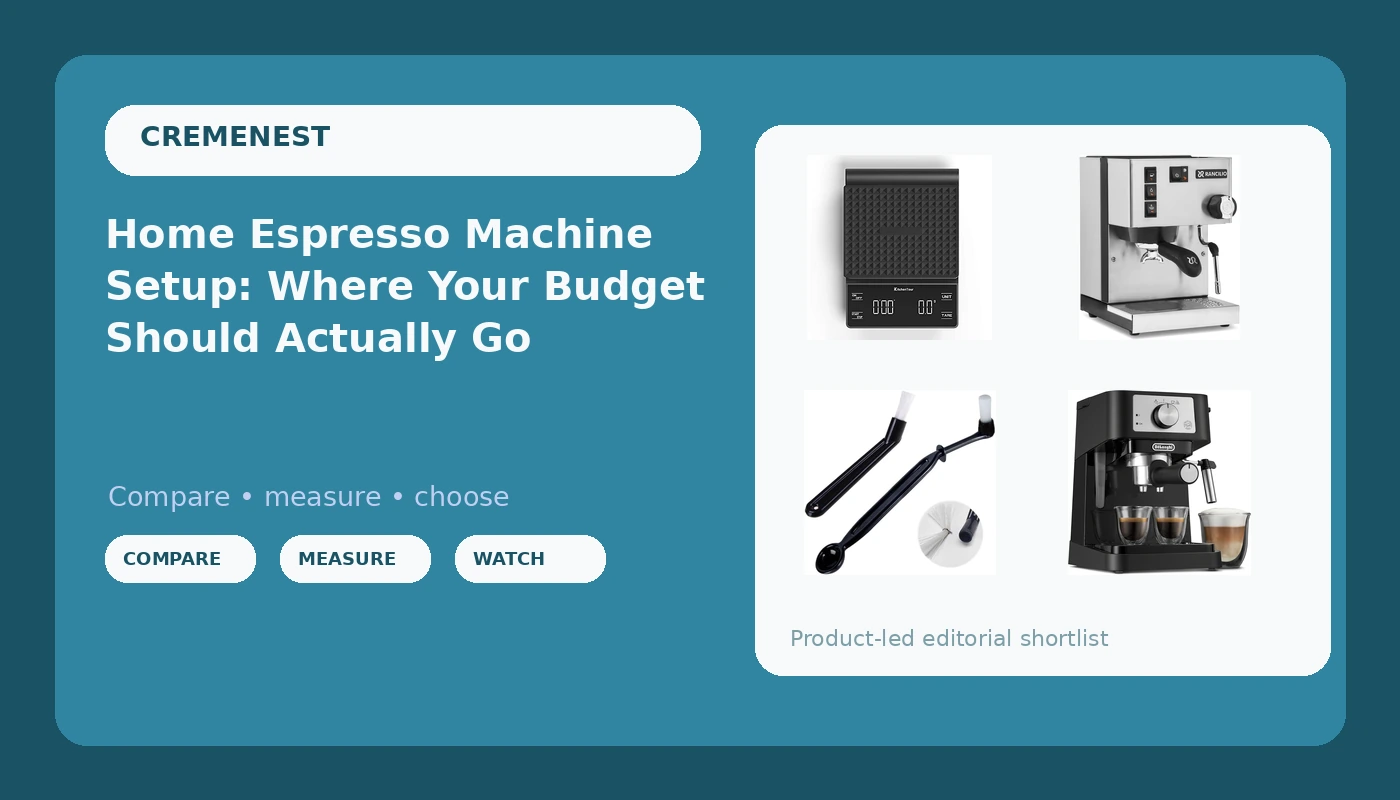
This explainer is about the order of operations. Four pieces of equipment cover the range from "I want to try this" to "I want a machine I will still own in ten years": a compact starter machine, a stainless steel step-up, a precision scale with a built-in timer, and a two-piece cleaning kit. Prices move constantly, so nothing here quotes one. What follows is what each piece does, who it fits, and where it stops being enough.
Related: How to Dial In an Espresso Shot Without Wasting Beans →
Quick answer
Match the machine to your counter and your patience, then buy the scale before anything else. If you are new and space is tight, the De'Longhi Stilosa is the least complicated way in. If you already know this is a long-term hobby, the Rancilio Silvia is the step up. The KitchenTour scale is the piece that makes either machine repeatable, and the cleaning brush set is the piece that keeps the taste the same in month six as it was in week one. A home espresso machine setup is judged by its worst shot, not its best.
Four useful options
| Model | Best fit | What stands out |
|---|---|---|
| De'Longhi Stilosa Compact Manual Espresso Machine | A first machine on a small counter | Compact manual body with a manual milk frother and a short learning curve |
| Rancilio Silvia Espresso Machine | Buyers who want one machine for a long time | Stainless steel construction and a simple, serviceable design |
| KitchenTour Coffee Scale with Timer | Anyone trying to repeat a good shot | 3kg capacity at 0.1g resolution, built-in timer, back-lit LCD, batteries included |
| Coffee Machine Cleaning Brush Set | Every machine owner, from day one | Two brushes plus a spoon tool, with nylon and stainless steel bristles |
Compact starter: De'Longhi Stilosa Compact Manual Espresso Machine
The trade-off with any compact machine is thermal mass. A small boiler and a light group mean the brew temperature moves around more than it does on a heavier machine, so the same beans can taste different from one shot to the next. That is not a reason to avoid it. It is a reason to pair it with a scale and to keep your routine identical each morning. Where this machine stops being enough is milk: a manual frother rewards technique and punishes impatience, so if you drink two flat whites a day you will feel the limits sooner than a straight-espresso drinker will.
Step-up machine: Rancilio Silvia Espresso Machine
The single boiler is the whole story here. You pull your shot, then you wait while the machine comes up to steam temperature, then you texture milk, then you wait again before the next shot. That dead time is fine for one drink. It is irritating for four drinks when guests are standing in the kitchen. What you get in exchange is a heavier, more stable machine with fewer electronics to fail, and a design simple enough that a decade of ownership is realistic. If you mostly drink espresso and only occasionally steam, this is the sensible ceiling. If you host brunch every weekend, it is the wrong shape of machine and no amount of technique fixes that.
The dial-in tool: KitchenTour Coffee Scale with Timer
Weigh the dose going in, weigh the liquid coming out, and you have two numbers that explain most of what went wrong. A shot that ran long and tastes thin is a grind problem you can now see. A shot that tastes sour is often under-extracted because you dosed by eye and the basket was fuller than you thought. Nothing else in a home espresso machine setup gives you that much information for that little money, which is why the scale belongs on the counter before the second machine does. The 0.1g resolution matters more than the 3kg capacity here; espresso doses are small, and a scale that rounds to the nearest gram hides the adjustment you just made.
The upkeep kit: Coffee Machine Cleaning Brush Set
Old coffee oil is not dirt, it is flavor, and it goes rancid. A machine that pulls beautiful shots on Monday tastes flat and slightly bitter by Friday if the group head and basket are never brushed. The routine takes under a minute: knock out the puck, brush the shower screen and the gasket, rinse the basket, wipe the steam wand after every use. Do it daily and the deep cleaning is rare. Skip it and you will spend a Saturday afternoon with a descaler and a bad mood, wondering why a machine you liked two months ago stopped tasting right.
Prices and availability may change. Product images, names, and retailer links must be matched by verified ASIN. Do not state a current price, rating, stock status, or measured result without current evidence.
What actually decides how a shot tastes
The machine sets the ceiling. The grind, the dose, and the water set the floor, and you live on the floor most days.
Grind is the biggest single variable in the cup. A machine that can hold temperature perfectly still makes bad coffee if the grind is wrong, because the water either races through the puck or stalls on top of it. This is why a modest machine paired with a capable grinder and a scale beats an expensive machine fed by pre-ground coffee, every single time. If your budget is fixed, spend on the grinder and the scale first and let the machine be the compromise.
Temperature stability is the second variable. Heavy boilers and stable groups hold brew temperature across the shot, which is what makes a shot repeatable rather than occasionally lucky. Light, compact machines drift. You compensate with consistency in everything you control: the same dose, the same tamp, the same beans, the same routine.
Pressure is the third, and it is the one most people never touch. Many budget machines ship running well above the pressure a classic espresso recipe assumes, which makes the puck harder to control and pushes shots toward harsh and thin. If your machine allows adjustment and your shots taste consistently bitter no matter what you do to the grind, that is worth investigating.
Beans and water sit underneath all of it. Coffee that was roasted six weeks ago will never taste like coffee roasted six days ago, and hard water will scale a boiler into an early grave. Neither is a machine problem, and neither can be fixed by upgrading the machine.
Matching the machine to the way you actually drink
Boiler design is the honest dividing line between machines, more than brand or finish.
- Compact thermoblock or small boiler: fast to heat, small footprint, less stable temperature, limited steam. Good for one or two drinks.
- Single boiler: stable brewing, real steam, but you wait between brewing and steaming. Good for espresso drinkers who steam occasionally.
- Heat exchanger: brew and steam at once, with a cooling flush to manage. Good for mixed households.
- Dual boiler: independent temperatures for brew and steam, no waiting. Good for people who make several milk drinks in a row, and priced accordingly.
Then work through the decision in order:
- Count the drinks you make on a normal weekday, not the ones you imagine on a Sunday.
- Measure your counter, including the clearance above the machine for filling the reservoir and locking in the portafilter.
- Set your grinder and bean budget before you set your machine budget.
- Buy the scale at the same time as the machine, not three months later.
- Buy the cleaning kit on day one and build the routine before the machine gets dirty.
Setting up the counter
- Keep the scale where it lives, not in a drawer. A tool you have to fetch is a tool you stop using.
- Weigh your dose and your yield every shot for the first month. After that you will know what correct looks like without thinking about it.
- Store beans in a sealed container away from light and heat, and buy amounts you will finish in two or three weeks.
- Brush the group head and rinse the basket after every session, and wipe the steam wand immediately after steaming.
- Use water you would be happy to drink, and check whether your machine's manual recommends filtered or softened water.
Which option should you choose?
Choose the De'Longhi Stilosa Compact Manual Espresso Machine when you are new to espresso, your counter is tight, and you want to learn the workflow without a large commitment. Choose the Rancilio Silvia Espresso Machine when you already drink espresso daily, you value a machine you can keep and service, and you can live with waiting between brewing and steaming. Choose the KitchenTour Coffee Scale with Timer when you want to stop guessing, which is almost immediately for most people. Choose the Coffee Machine Cleaning Brush Set when you want the machine to taste the same next month, which applies to every machine on this page.
One caveat: none of these four pieces fixes a bad grinder. If your grinder cannot produce a fine, consistent grind, the machines here will still make coffee you would rather not drink, and no accessory in this list will rescue it. Budget for the grinder first, or accept that you are buying a learning setup rather than a finished one.
The bottom line
A home espresso machine setup is a chain, and the machine is only the most visible link. The compact machine gets you started with the smallest footprint and the gentlest learning curve. The stainless steel single boiler is the machine you grow into and keep. The scale is what turns a lucky shot into a repeatable one, and the brush set is what keeps the taste stable over months rather than days. Buy in that order, weigh everything, clean as you go, and the shots get better on their own.