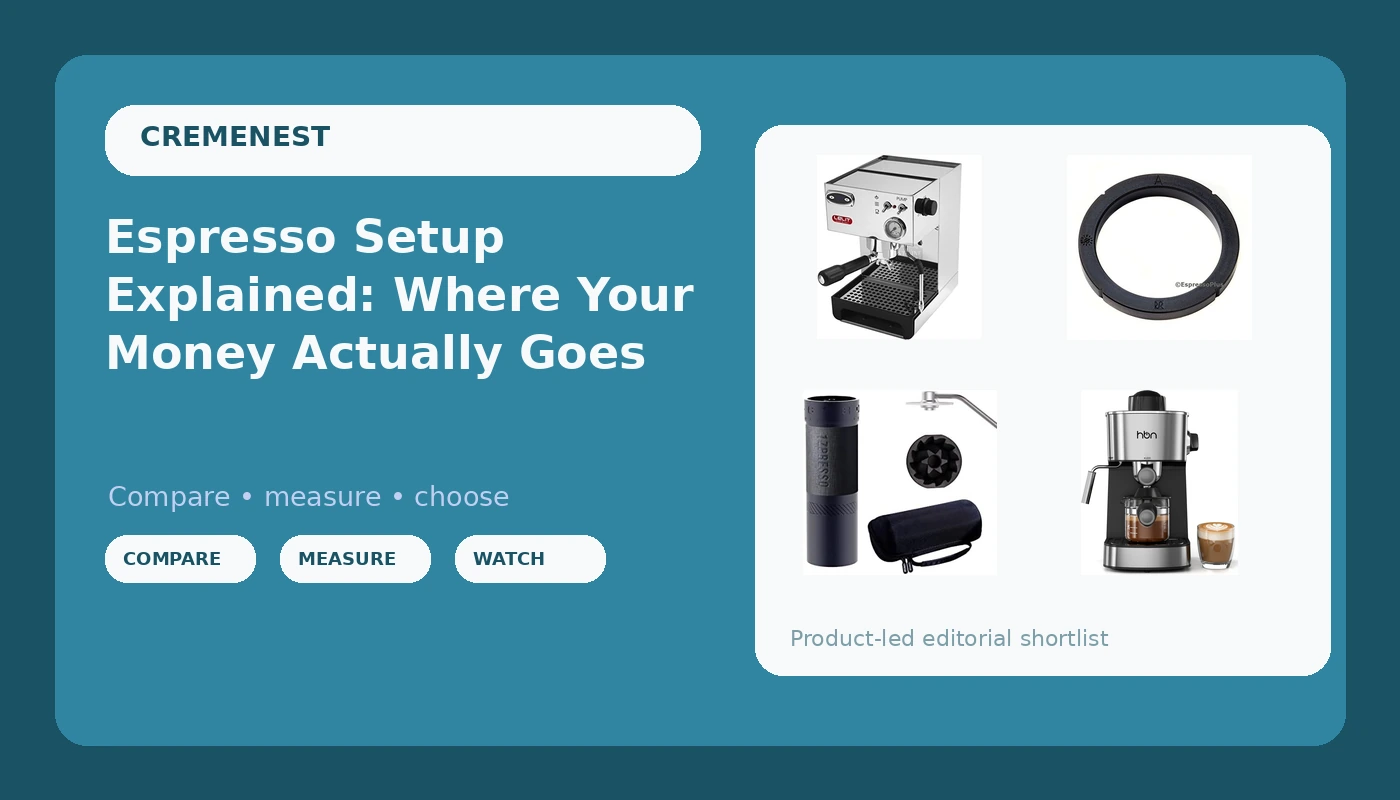
Most people build a home espresso setup from the wrong end. They start with the machine, which is the most visible, most expensive, and least decisive piece of the whole kit. Twelve years behind a bar and a long run of kitchen-counter consults have taught me the same lesson every time: the grinder sets the ceiling on what a machine can produce, and the machine only has to hold temperature steady enough for the grinder's work to show up in the cup.
That is the frame for this explainer. The four products below are not competitors. They answer four different questions in a home espresso setup. One is the priority purchase, one is the temperature-stable machine you graduate into, one is a low-cost entry point for milk drinks, and one is a wear part that keeps a machine you already own out of the landfill. Working out which question you are actually asking is most of the decision.
Related: How to Choose an Espresso Grinder: Burrs, Settings, and Budget →
Quick answer
Buy the grinder first, then the machine, then the parts that keep it running. The J-Max Iron Gray is a hand grinder, and a grinder is the piece that decides whether espresso is possible in your kitchen at all. If grinding is already handled, the Lelit PL41TEM Anna Espresso Machine with its PID controller is the step up for anyone chasing repeatable shots. The HBN Espresso Machine is a compact 800W option with a built-in frother, and its listed 3.5 bar pressure sits well below the 9 bar that traditional espresso extraction assumes, so treat it as a small milk-drink machine rather than a traditional espresso platform. The Rancilio Silvia Group Head Gasket is not a machine: it is the OEM replacement part for a Silvia that has started leaking at the group.
Four useful options
| Model | Best fit | What stands out |
|---|---|---|
| J-Max Iron Gray | Fixing the weakest link first | Hand grinder; grinding is the variable that sets shot quality |
| Lelit PL41TEM Anna Espresso Machine - PID | Repeatable straight shots at home | PID temperature control named in the model |
| HBN Espresso Machine, 3.5Bar Cappuccino & Latte Maker | Milk drinks on a small counter | 800W, built-in frother, listed 3.5 bar pressure, 2 to 4 cup capacity |
| Rancilio Silvia Group Head Gasket | Keeping an older Silvia in service | OEM part number 36301030, stated as a genuine Rancilio part |
The priority purchase: J-Max Iron Gray
Here is the honest version of the grinder argument. Espresso is water pushed through a compressed bed of coffee at pressure. The pressure is the machine's job, and most machines can manage it. The bed is the grinder's job, and a grinder that produces an uneven particle spread cannot build a bed that resists the water evenly. Water finds the loose spots, the shot runs fast, and you get thin, sour coffee no matter how much you spent on the machine. That is why the grinder comes first in a home espresso setup, and why a hand grinder is often the smart money: with no motor, housing, or control board in the bill of materials, more of the cost sits in the part that touches the coffee.
The trade-off is you. Hand grinding for espresso takes effort and a stretch of cranking per shot, and if you are making four milk drinks back to back at seven in the morning, you will feel it in your forearm. For one or two shots a day, that is a fair trade, and it is the upgrade I would make before touching the machine.
The temperature step: Lelit PL41TEM Anna Espresso Machine - PID
Temperature stability is the feature you feel on every shot, and it is where a PID controller earns its place. A mechanical thermostat lets brew temperature drift across a range, so one shot tastes right and the next tastes sour or bitter when nothing on your end changed. A PID controller holds its target far more tightly, which means that when you change one variable, grind or dose or bean, you can actually read the result instead of guessing whether the machine moved under you.
The trade-offs are worth naming. A PID machine does not fix a weak grinder, and it does not shorten the wait for steam on a single-boiler design, which is the point in the workflow where patience gets tested. It also will not make a bad bean taste good. What it does is remove one source of noise from a process that already has plenty. If you pull straight shots and you want them to taste the same on Tuesday as they did on Sunday, this is the category to shop in.
The entry point: HBN Espresso Machine, 3.5Bar Cappuccino & Latte Maker
Not everyone needs to start at nine bar with a serious grinder, and the HBN listing is unusually clear about what it is: 800W, a stainless steel body, a built-in milk frother, and a 2 to 4 cup capacity in a compact footprint. The number that matters most is the one in the name. The 3.5 bar figure sits far below the pressure that traditional espresso extraction assumes, so this is not going to produce the dense, syrupy shot a pump machine produces. What it will do is heat water, steam milk, and deliver a small, sweet, milk-forward drink on a counter with no room for anything else.
The trade-off is ceiling, not safety. You are buying a cappuccino and latte maker for a home or office counter, not a platform you grow into, and no later upgrade will change that. If your goal is a warm milk drink before work and you are not chasing a 25-second shot, the cost of admission is low and the workflow is short. If you want to learn extraction, this is the wrong door to walk through.
The maintenance part: Rancilio Silvia Group Head Gasket
Every machine in this article has rubber parts that wear out, and the group head gasket is usually the first to go. It is the seal between the group and the portafilter. When it hardens, water escapes around the basket instead of through it, the portafilter handle starts to feel loose when you lock it in, and the shot degrades for reasons that have nothing to do with your grind. On a Rancilio Silvia this is a routine replacement, and the listing states the OEM part number and describes the part as genuine Rancilio stock supplied direct.
The trade-off is obvious: it does nothing for anyone who does not own a Silvia. As a purchase it is unglamorous and easy to forget until the leak starts. As a reason to keep an older machine in service rather than replace it, it is one of the cheapest fixes in espresso, and it is the difference between a machine that gets retired and one that keeps pulling shots.
Prices and availability may change. Product names, images, and retailer links here are matched to the listings shown. Confirm the current price, rating, and stock status on Amazon before buying.
What pressure and temperature actually do to a shot
Two numbers do most of the work in espresso, and they are easy to confuse because both get printed on the box.
Pressure is what the pump delivers to the group. Traditional espresso extraction assumes roughly 9 bar, and much of the advice you read online about grinders, baskets, and shot times assumes you are working at or near that figure. A machine listed at 3.5 bar is not failing at anything; it is simply built for a different job, closer to steam-driven coffee than to pump extraction. The practical consequence is that the puck never meets enough resistance to matter, so the grind becomes far less critical and the resulting drink is lighter and less concentrated. That is the honest trade for a compact machine at an entry price.
Temperature is what determines whether the flavors you extract are the ones you want. Coffee solubles come out in a rough order, with fruity acids first and bitter compounds later. If brew temperature swings between shots, you are effectively moving the finish line each time, and dialing in becomes guesswork. A PID controller narrows that swing, which is why it shows up in the model name of the Lelit here and why it matters more day to day than exotic pressure features most people use twice and then forget.
Neither number rescues a bad grinder. Pressure and temperature are the machine's contribution to the shot; particle size distribution is the grinder's. When both are reasonable, the workflow is calm and the coffee tastes like the bean.
How to build a home espresso setup in the right order
- Decide what you actually drink on a normal weekday, not on a Sunday morning with guests. A daily latte is a different machine than a daily straight shot, and a machine that serves both well costs more than one that serves either.
- Set the grinder budget before the machine budget. If the total is limited, put the larger share into the grinder and buy the cheaper machine, because the grinder travels with you across every machine you will ever own.
- Match the machine to the grinder you can afford, not the other way around. A PID machine with no capable grinder is an expensive thermometer; a hand grinder with a steam machine will still make better coffee than pre-ground beans in a pump machine.
- Leave room for wear parts and consumables. Group gaskets, baskets, cleaning powder, and descaler are small line items that decide whether year three is pleasant or a leak.
- Plan for the workflow you will keep. Count the minutes from cold start to first sip, including grinding, and ask whether you will still do that on a dark February morning.
What to check before you click buy
- Confirm the pressure and the basket type in the listing, because a low-pressure or pressurized setup behaves very differently from a traditional 9 bar machine.
- Check whether the machine ships with a real portafilter basket or a pressurized one, since a pressurized basket hides stale beans and coarse grind instead of revealing them.
- Read the model designation carefully for feature markers such as PID, which signal electronic temperature control rather than a mechanical thermostat.
- For replacement parts, match the OEM part number to your machine before ordering, and confirm the listing states the part fits your model.
- Budget for the grinder even if the machine is the thing you are excited about, because that is the decision you will live with longest.
Which option should you choose?
Choose the J-Max Iron Gray when you are starting from nothing and want the single purchase that improves every cup, or when you already own a machine and suspect the grinder is the bottleneck. Choose the Lelit PL41TEM Anna Espresso Machine - PID when grinding is handled and you want straight shots that taste the same on consecutive days. Choose the HBN Espresso Machine, 3.5Bar Cappuccino & Latte Maker when your drink is milk-forward, your counter is small, and you want a short workflow rather than a project. Choose the Rancilio Silvia Group Head Gasket when you already own a Silvia and the group has started dripping or the portafilter no longer locks in firmly.
One caveat that applies to all four: none of this is a substitute for fresh coffee and a scale. The grinder, the machine, and the gasket are the hardware. The bean, the ratio, and the water are the other half of the equation, and no purchase on this page fixes a bag of coffee roasted eight months ago.
The bottom line
A home espresso setup is a system, and the parts are not interchangeable in importance. The grinder does the most work, the machine holds the temperature steady enough for that work to be readable, and the gasket is what keeps an older machine in the game instead of on a curb. If you are deciding where to start, start with the J-Max Iron Gray and let the machine decision follow your budget. If you are deciding where to go next, the Lelit PL41TEM Anna with its PID controller is the meaningful step for straight shots, while the HBN machine serves the small-counter, milk-drink case without pretending to be something else. And if you already own a Rancilio Silvia that leaks at the group, the OEM group head gasket is the cheapest repair decision you will make all year.