Related: How to Dial In Espresso Without Wasting a Pound of Beans
I have pulled somewhere north of 40,000 shots. I managed a third wave coffee bar for years, and I have set up espresso stations for friends, family, and two cafes. So when people ask me about home espresso machines, I open with the sentence nobody wants to hear: the machine is not where the flavor comes from.
The grinder is roughly 70% of the shot. A $500 machine with a $300 grinder beats a $2,000 machine with a $50 grinder, every single time. If your total budget is $900, spending $800 on the machine and $100 on the grinder is a mistake, and the reverse is not. I have watched people spend four figures on a dual boiler and feed it supermarket pre-ground, and I have watched someone with a modest single boiler and a serious burr grinder pull shots that beat the cafe down the street.
This guide covers the machine half of that equation. Four machines, four very different workflows, and one test that matters more than any spec sheet: would I still enjoy this thing in month three? Every recommendation here comes with the grinder advice attached, because no machine in this lineup makes good coffee on its own.
Best Overall: Breville Barista Express
The Barista Express is the machine I hand to beginners, and I hand it over with one caveat: the built-in grinder is mediocre. Workable, but mediocre. It will grind fine enough to teach you what dialing in actually feels like, and it will not be the last grinder you own. No built-in grinder at this end of the market is.
What you get for that compromise is the shortest possible path from wanting espresso at home to drinking espresso at home. One box, one plug, one hopper, one brushed stainless footprint. There is no shopping list, no grinder research rabbit hole, no second package to wait on. For a lot of people that is the difference between a hobby that starts and a hobby that stays a wish.
The workflow is forgiving in the right ways. It is a single boiler, so you brew, then you wait, then you steam, and that rhythm teaches you to think in order. If you want the full ritual, pulling a shot and steaming milk back to back without a pause, you are shopping in a different bracket. If you want one machine on the counter that makes a good flat white on a Tuesday, this is where the conversation starts.
Pair it with fresh beans, a scale, and a real tamper. Use the built-in grinder until it annoys you, then buy a standalone burr grinder and keep the machine.
Best for Tinkerers: Gaggia Classic Pro
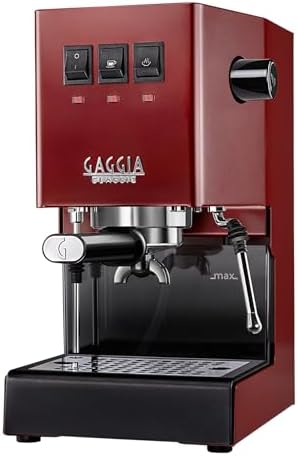
The Gaggia Classic Pro is the best budget modder's dream, full stop. The bones are the reason: simple, serviceable, and endlessly documented by people who have already made every mistake you are about to make. I modded one into something unrecognizable, and I still keep it around for the days I want to pay attention to what I am doing.
The 1.3 liter reservoir and the cherry red housing are the easy parts to describe. The interesting part is the over-pressure valve. Most budget machines ship well above 9 bar at the group, and an OPV spring swap is the cheapest, most dramatic improvement you can make to a machine this size. That one change turns harsh, channeling shots into something sweeter and more forgiving. If you are willing to open the machine, this is the one that pays you back.
The honest downside is the stock steam wand. It is weak, and texturing milk on it takes longer to learn than almost anything else in this lineup. You will either practice through it or swap it, and both are legitimate. What you should not do is buy this machine expecting it to be convenient out of the box. It is a project, and projects are the point.
Budget for a standalone grinder here. With the Barista Express the grinder is included and mediocre; with the Gaggia there is no grinder at all, so the money you did not spend on a bigger machine should go into burrs.
Best Small Footprint: Breville Bambino Plus
Some kitchens do not have room for a project. The Bambino Plus in black stainless steel is the pick for a counter that is already crowded, and the whole pitch is speed: it is ready to brew while a dual boiler is still warming its group. At 6:40 in the morning, before anyone has spoken a word, that is not a small feature.
What you give up is the learning. The machine handles parts of the job that a Gaggia makes you handle yourself, and anything a machine does for you is something you never learn to do by feel. That is a real trade, not a marketing footnote. If your goal is a good cup with minimal ceremony, take the deal. If your goal is to understand milk texture, this is not the teacher.
There is no grinder in this box, so this is the section where the grinder advice matters most. Spend more here than feels reasonable, then spend the rest on the machine. A Bambino Plus with a real burr grinder makes better coffee than a machine twice the size with a blade grinder, and I will argue that in any kitchen.
One more thing to check before you buy: clearance above the machine. Small footprint machines still need room for a portafilter and a pitcher, and a cabinet that blocks the steam wand turns a good machine into an annoying one.
Best Budget Starter: Pantrymade 20 Bar Espresso Machine
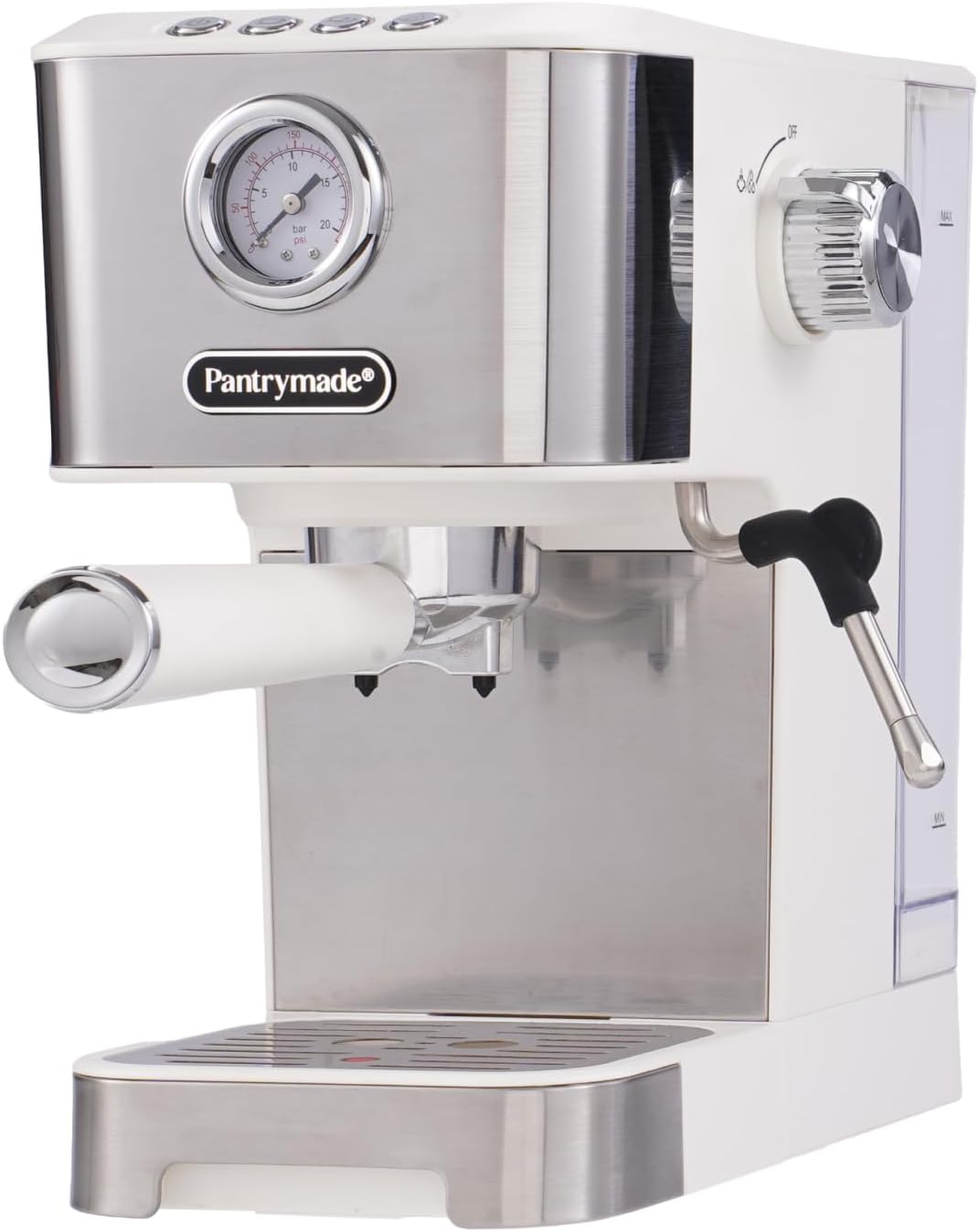
Start with the number on the box. Twenty bar is a marketing figure, not a target. Espresso wants roughly 9 bar at the group, and most budget machines ship well above that, which is exactly why the pressure gauge on this Pantrymade is the feature I actually like. A gauge lets you see what the machine is doing instead of guessing, and that is worth more than three extra bars of headroom you will never use.
The other feature in the name is the milk frother. A frother is not the same tool as a steam wand, and the difference is texture. Froth is airy and collapses into big bubbles; properly textured milk is glossy and pours like wet paint. If you want latte art, this is not the machine that will teach you. If you want hot milk in your coffee without leaving the kitchen, it does the job.
Before you buy, check two things. First, whether it ships with a pressurized basket as the default. Pressurized baskets hide stale beans and bad grind, which feels great for a week and teaches you nothing. Second, what the over-pressure valve is set to, because that is the single biggest variable in how the shot tastes.
Then take the grinder seriously. This is a starting point, not a destination.
How I judge a machine
Every machine I form an opinion about gets a minimum of 30 shots pulled on it. Same beans, same grinder, same water, same scale, same tap water recipe. I do not review a machine from a spec sheet, and I do not photograph crema and call it a verdict. Crema is decoration. Taste is the test.
I run three checks. First, dial-in window: how wide is the range of grind settings that still produces a drinkable shot? A machine with a narrow window is exhausting after a month. Second, temperature stability: does the brew water hold steady across the shot, or does it drift and hand you a shot that is sometimes great and sometimes sour with no explanation? Third, the month three question: after a month of daily use, do I still want to walk over and pull another one, or am I reaching for the kettle?
I also time the dead time, the wait between brew and steam on a single boiler. Ten seconds is nothing. Forty seconds is where your morning patience goes to die.
What actually matters, and what is marketing
Grind quality. This is the whole game. A machine can only work with what you feed it, and no feature on any box fixes a bad grinder.
Over-pressure valve. The difference between 9 bar and 12 bar at the group is the difference between a sweet shot and a harsh one. Adjustable is better than not, and moddable is the next best thing.
Temperature stability. Pressure profiling is a feature most people use twice and then forget. Temperature stability is a feature you feel on every single shot. Buy the second one.
Portafilter size. A real 58mm basket means a thicker puck and more forgiveness. Smaller baskets are not disqualifying, but they are an uphill walk, and you should know that going in.
Water and descaling. If a machine needs descaling every two weeks, the machine is not the problem, your water is. Filtered water costs less than a descaling kit and saves the machine.
A steam wand versus a frother. If you care about milk texture, this is non-negotiable. If you do not, save the money and stop reading reviews about wand angles.
The home espresso machine reference table
This is the table I keep in my head when someone tells me their budget, their counter space, and how many cups they make before work. Read the "what to check" column before you click anything, because that is the column that decides whether you are happy in month three.
| Machine | Best for | Grinder plan | What to check before you buy | Verdict |
|---|---|---|---|---|
 Visit on Amazon → Visit on Amazon →Breville Barista Express |
One box, no shopping list | Built in, workable, upgrade later | Whether the finest setting reaches a slow, syrupy shot with your beans | The gentlest start in this group |
 Visit on Amazon → Visit on Amazon →Gaggia Classic Pro |
Tinkerers and modders | Buy separately, spend freely | What the OPV is set to, and whether a spring kit is in your future | Best bones to build on |
 Visit on Amazon → Visit on Amazon →Breville Bambino Plus |
Small counters, fast mornings | Buy separately, no excuses | Cabinet clearance above the machine and room for a pitcher | Speed over ceremony |
 Visit on Amazon → Visit on Amazon →Pantrymade 20 Bar Espresso Machine |
First machine on a real budget | Buy separately, this is where the money goes | Whether the default basket is pressurized and what the gauge reads at the group | A starting point, not a destination |
If you only remember one line from this table, make it the grinder column. Every machine here improves when the grinder improves. None of them improve when the machine improves and the grinder stays bad.
Should you buy the Breville Barista Express?
Yes, if you want one box and no shopping list. The built-in grinder is mediocre but workable, the learning curve is gentle, and it teaches you what dialing in feels like before it makes you want a real grinder. That is a fair trade for a first machine, and it is the one I recommend most often to people who want to start this weekend rather than research for a month.
Should you buy the Gaggia Classic Pro?
Yes, if you like taking things apart. An OPV spring swap transforms the shot, the parts supply never dries up, and the bones are worth building on for years. The stock steam wand is weak, so plan on practice or a swap, and plan on buying a grinder. It rewards tinkerers and quietly punishes anyone who wanted automation.
Should you buy the Breville Bambino Plus?
Yes, if counter space and speed matter more than ceremony. It is ready to brew while a dual boiler is still warming up, it fits where a bigger machine will not, and it leaves your grinder budget intact. What you give up is the learning, because anything the machine does for you is something you never learn to do by feel. For a lot of kitchens, that is the right call.
Should you buy the Pantrymade 20 Bar Espresso Machine?
Yes, as a starting point and not a destination. Ignore the 20 bar figure, use the pressure gauge to learn what the machine is doing, and check whether the default basket is pressurized before you build a habit around it. If the budget is real, this gets you pulling shots now and upgrading the grinder first, which is exactly the right order.