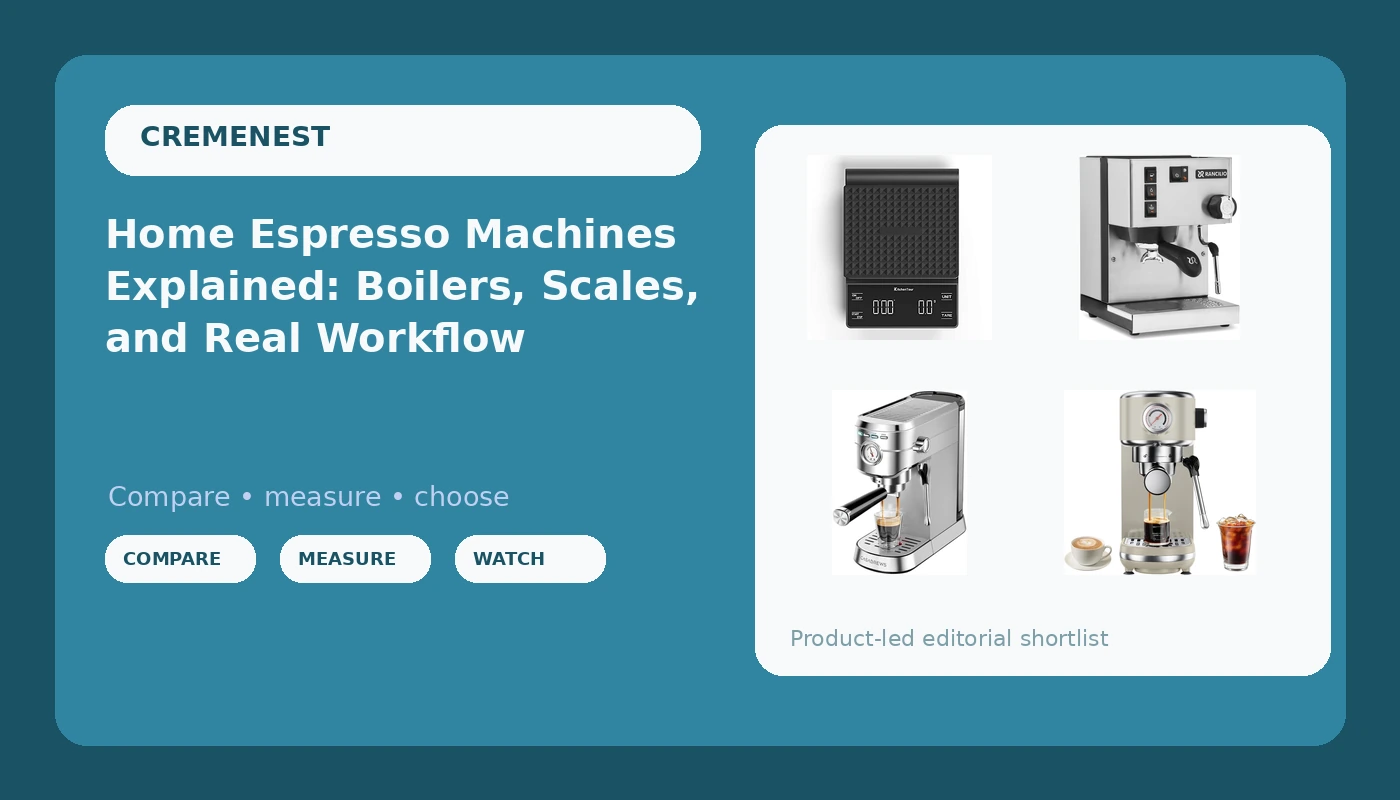
Most people shopping for home espresso machines start with the machine and finish with disappointment. The machine is the visible purchase, the one with the steam wand and the brushed steel, but what lands in the cup is decided by less photogenic variables: how steady the brew water stays across a shot, how large the basket is, whether pump pressure is actually regulated down to something espresso likes, and how long you wait between finishing a shot and steaming milk. This explainer walks through those variables in plain language, then maps four specific products onto the jobs they actually do: two machines at different points on the ladder, one compact option for tight counters, and the small tool that makes all of them repeatable.
Related: How to Dial In an Espresso Grinder Without Wasting a Bag of Beans →
Quick answer
Buy the machine that matches the workflow you will actually keep, not the one you imagine using on a slow Sunday. If you drink straight espresso and want something you can maintain for years, a single-boiler machine built around standard commercial parts, like the Rancilio Silvia, is the more durable path. If your counter is small and milk drinks are the point, the CASABREWS CM5418 is built for that brief. If you want the lowest-cost way to start pulling shots with a frother on board, the atatix machine covers it. Whichever you choose, add the KitchenTour scale: weighing your dose and your yield is the change most likely to improve your shots for the least money.
Four useful options
| Model | Best fit | What stands out |
|---|---|---|
| Rancilio Silvia Espresso Machine, Stainless Steel | A first serious machine you plan to keep | Stainless steel build with a single-boiler design and a dedicated steam workflow |
| CASABREWS CM5418 Compact Espresso Machine with Milk Frothing Steam Wand | Small kitchens that still want steamed milk | Compact body paired with a milk frothing steam wand |
| atatix Espresso Machine with Milk Frother, 20 Bar Pressure Espresso Maker | The lowest-cost entry into milk drinks | A 20 bar pressure spec and an integrated milk frother |
| KitchenTour Coffee Scale with Timer | Anyone dialing in by weight | 3kg capacity at 0.1g resolution with a built-in timer and back-lit LCD |
The step-up machine: Rancilio Silvia Espresso Machine
The trade-off is the boiler. A single-boiler machine heats one volume of water and uses it for both brewing and steaming, so the workflow runs in two acts: pull the shot, wait for the boiler to climb to steam temperature, then texture milk. That wait is the "dead time" home baristas talk about, and it is a real pause rather than an instant switch. In exchange you get simplicity, fewer failure points, and a machine that behaves like a scaled-down commercial unit once it is warm. Budget for a grinder before you budget for this machine. A capable burr grinder matters more than the badge on the front panel.
The compact pick: CASABREWS CM5418 Compact Espresso Machine
Compact machines make a specific trade. Smaller boilers hold less thermal mass, which makes it harder to keep brew temperature steady from shot to shot, and steam wands on small machines usually reward a slower, more patient approach to milk. Neither is a dealbreaker; both are things to know before you buy. The other question worth asking is which basket ships in the box. If the default is pressurized, treat it as a starting point rather than the destination, because a pressurized basket masks stale beans and a grind that is not fine enough. Move to a standard basket as soon as your grinder can keep up.
The entry pick: atatix Espresso Machine with Milk Frother
Twenty bar is a pump rating, not the pressure at the puck. Espresso is generally extracted somewhere around 9 bar, and machines regulate pump output down through an over-pressure valve, usually called the OPV. A high pump rating is closer to a durability and headroom spec than a flavor spec. What actually separates a budget machine from a mid-range one is how well that regulation holds, how stable the temperature stays across a 30-second shot, and whether the steam wand can texture milk rather than simply blow hot air into it. Those are the questions to hold onto when a listing page leads with a big number.
The measuring tool: KitchenTour Coffee Scale with Timer
Resolution is the reason to care about 0.1g. On a typical 18 gram double dose, half a gram of error is roughly three percent of the coffee, which is enough to move a shot from balanced to sour or from balanced to bitter without you changing anything else. The timer matters for the same reason: dose, yield, and time together are the three numbers that let you repeat a good shot instead of hoping for one. A scale like this one also works for pour over and drip, so it is not a single-purpose purchase that becomes clutter when you upgrade the machine.
Prices and availability may change. Product images, names, and retailer links must be matched to the correct product record. Do not state a current price, rating, stock status, or measured result without current evidence.
What boiler design actually changes
The boiler is the part of the machine that decides your morning. There are three broad approaches in home machines. A single boiler heats one volume of water and switches between brewing and steaming, which means a pause in the middle of a milk drink. A heat exchanger keeps a brew boiler and a steam boiler in one vessel, so you can steam while brewing, but brew temperature is managed less directly. A dual boiler gives each job its own heated water, which is the setup that makes temperature stability easiest to hold shot after shot.
Temperature stability is the term worth learning. It describes how steady the brew water stays across the roughly 25 to 30 seconds of a shot. A machine with good stability gives you a shot you can reproduce tomorrow. A machine with poor stability gives you "sometimes great, sometimes sour," which is far more frustrating than a machine that is simply mediocre every time, because you cannot tell whether the variable you changed is the one that mattered.
Pressure works alongside temperature. Espresso wants somewhere in the region of 9 bar at the puck, and most machines achieve that by letting the pump run higher and bleeding the excess off through the OPV. This is why a 20 bar rating on a box is not a quality signal on its own.
Dialing in by weight, not by eye
Eyeballing a shot is how most home setups stall. Volume in the cup is a poor proxy for what you extracted, because crema takes up space and volume, and a shot that looks right can be badly under-extracted. Weight is the honest measurement. Pick a dose, pick a yield as a multiple of that dose, and record the time it took. Then change one thing at a time.
A repeatable starting sequence:
- Weigh your dose on the scale. Around 18 grams is a common starting point for a double basket.
- Distribute the grounds evenly in the basket and tamp level, not hard.
- Set the cup on the scale, tare it, and start the timer as the pump starts.
- Stop the shot when the yield reaches roughly twice the dose by weight, and note the time it took.
- Adjust one variable only. If the shot ran fast and tastes thin or sour, grind finer. If it ran slow and tastes dry or bitter, grind coarser. Change nothing else until you have a direction.
Practical guidance for a real kitchen
- Measure the counter before you buy. Check height under the cabinets and depth from the wall. A machine you have to shuffle sideways to fill is a machine you will stop using.
- Budget the grinder before the machine. A mid-priced machine with a good burr grinder beats an expensive machine with a cheap one, every time.
- Count the steam wait as part of the ritual. If most of your drinks are milk-based, the pause between brew and steam is a daily cost, not a footnote.
- Use water you would drink. Scale and chlorine are the two most common reasons a machine ends up needing descaling constantly.
- Keep the scale on the counter, not in a drawer. A tool you have to fetch is a tool you will skip.
Which option should you choose?
Choose the Rancilio Silvia Espresso Machine, Stainless Steel when you want a machine to grow into, you drink espresso and milk drinks in roughly equal measure, and you are willing to pair it with a real grinder. Choose the CASABREWS CM5418 Compact Espresso Machine with Milk Frothing Steam Wand when counter space is the binding constraint and you still want steamed milk rather than a frother alone. Choose the atatix Espresso Machine with Milk Frother, 20 Bar Pressure Espresso Maker when you want the least expensive route into espresso with milk drinks and you accept the compromises that come with it. Choose the KitchenTour Coffee Scale with Timer alongside any of them, because dose and yield are the two variables you can control on every machine listed here.
One caveat worth stating plainly: none of these machines fixes stale beans, and none of them substitutes for a grinder that can grind fine enough for espresso. The listing page describes the machine. Your workflow describes your mornings.
The bottom line
The machine matters less than the variables around it. Boiler design sets how long you wait and how repeatable your shots are, brew pressure regulation determines whether the puck sees a sensible pressure, and a scale turns all of it from guesswork into something you can adjust deliberately. Among these four, the Rancilio Silvia is the long-haul choice, the CASABREWS CM5418 is the space-conscious one, the atatix is the entry point, and the KitchenTour scale is the inexpensive addition that makes any of them easier to dial in. Pick the workflow you will genuinely keep, then buy the machine that fits it.