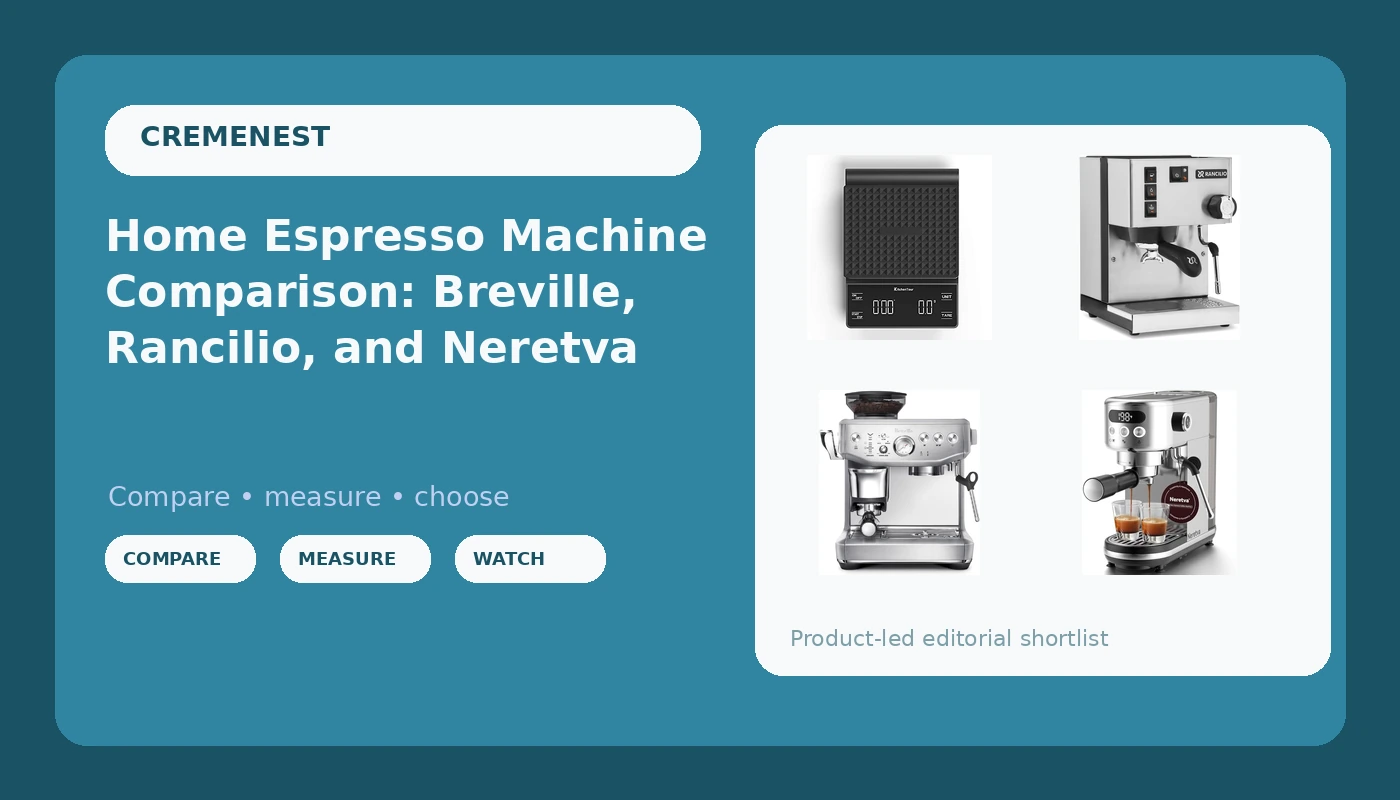
I have pulled something north of 40,000 shots in twelve years behind a bar and in other people's kitchens, and I still get the same question every time someone sees my setup: which machine should I buy? This home espresso machine comparison is my attempt to answer it once, in writing, for four products that cover most of the realistic ways into the hobby. Two are full-size machines, one is a compact budget pick, and one is not a machine at all but a scale that will change your coffee more than most machine upgrades.
Related: Why Your Grinder Matters More Than Your Espresso Machine
The short answer: if you have never pulled a shot and you want one box on the counter, the Breville Barista Express Impress is the machine I would hand you. If you already own a real grinder and want a machine you will still be using in 2038, the Rancilio Silvia is the better long-term buy. The Neretva 20 Bar is for the small counter and the smaller budget. The KitchenTour scale belongs on all three.
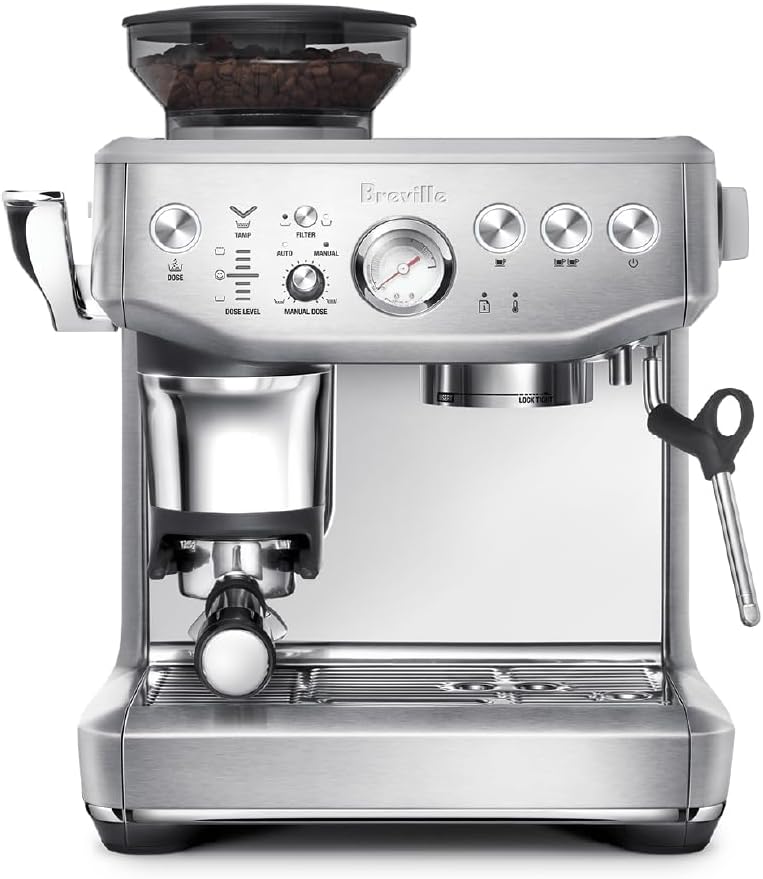
Breville BES876BSS Barista Express Impress
Grinder, machine, and a guided tamping lever in one box, which removes the single most common beginner error
The built-in grinder is the weak link, and the smaller basket size limits your choice of accessories
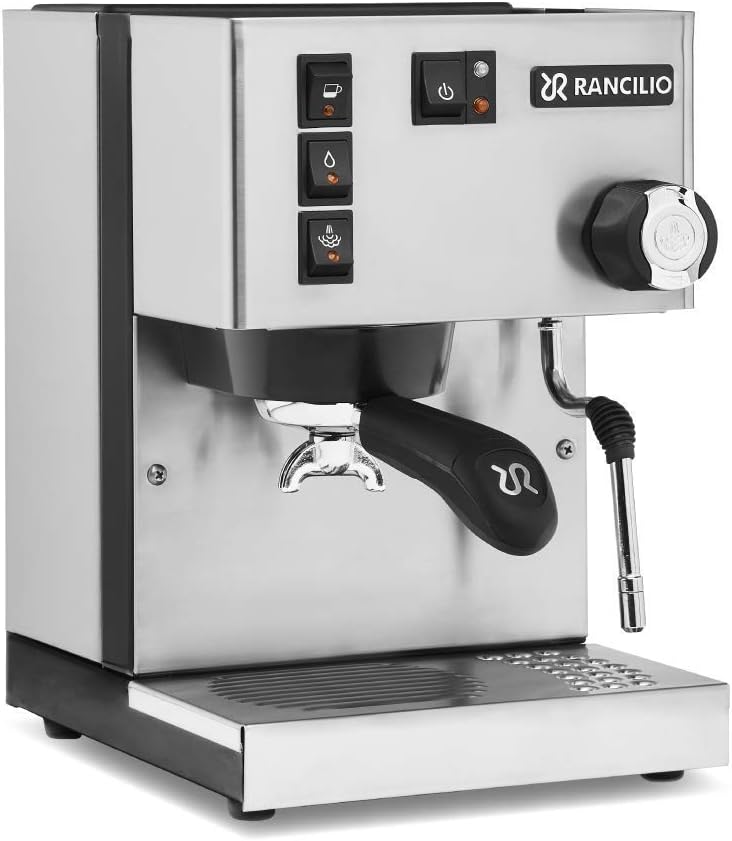
Rancilio Silvia Espresso Machine
Commercial heritage, a full-size professional basket, and parts availability measured in decades
Single boiler means you wait between brewing and steaming, and there is no grinder in the box
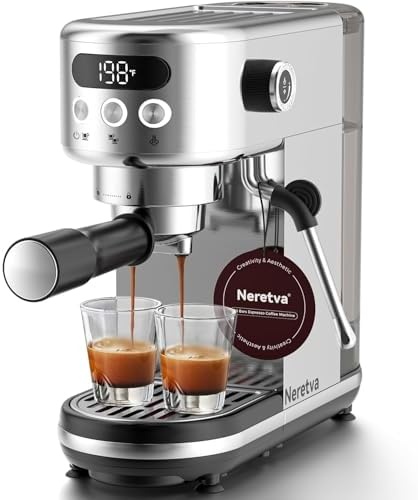
Neretva 20 Bar Espresso Machine Super Compact
Genuinely small footprint and the lowest entry price of the three machines here
Budget machines in this class usually ship with a pressurized basket, and the internals are plastic-heavy

KitchenTour Coffee Scale with Timer
Precise dosing and a built-in timer for less than two bags of good beans
It is a scale. It cannot rescue a bad grinder, and it will not steam milk
Prices and availability were captured from Amazon Creators API and may change.
What actually decides whether you enjoy this
Four things matter more than the badge on the front of the machine, and none of them are on the marketing sheet.
The first is temperature stability, which is how steady the brew water stays across a shot. Steady water gives you consistent espresso. Unsteady water gives you a shot that is sometimes sweet and sometimes sour, and you will spend months blaming your beans for it.
The second is basket size. If the machine does not take a real 58mm portafilter, you are working with a thinner puck and less forgiveness. Smaller baskets are not fatal, but they narrow your options for the rest of your life with the machine.
The third is dead time, the wait between pulling a shot and steaming milk on a single boiler. On a machine with one boiler, that wait is real, and it is where most weekday morning workflows die.
The fourth is the grinder, and it is not part of the machine at all. A great machine with a bad grinder makes bad coffee every single time. That is not an opinion I will soften for anyone.
Breville Barista Express Impress: the beginner's one-box answer
The Barista Express Impress is the machine I recommend to people who want to make espresso at home and have never done it. It puts a conical burr grinder, the brew group, and a tamping lever that presses and levels the puck for you into a single footprint. That lever matters more than it sounds. The most common beginner failure is an uneven tamp, and this machine simply removes that variable from your morning.
The honest criticism is the grinder. It is workable, it will get you into the espresso range with fresh beans, and it will teach you what grind adjustment does. But it is not the grinder you keep. When you eventually upgrade to a standalone grinder, you will taste the difference in the same machine on the same day.
The other compromise is the basket size. It is smaller than the professional standard, which means fewer aftermarket baskets and tampers fit. For a first machine that is a fair trade. Just know you are buying into a smaller ecosystem.
Rancilio Silvia: the machine you keep
The Silvia is the machine I point people toward when they already own a grinder and they are done experimenting with appliances. It uses a full-size professional basket, it is built like a small commercial machine, and it has been in production long enough that replacement parts will be available long after most of the machines sold this year have been recycled.
The trade-off is workflow, and it is not small. It is a single boiler, so you pull your shot, then you wait for the machine to come up to steam temperature before you texture milk. On a quiet Sunday that is a pause. On a weekday with two people who want lattes before work, it is a bottleneck, and you need to decide honestly whether you will tolerate it.
What you get in return is a machine that rewards good habits. Feed it a proper grind, keep your basket clean, and it will pull shots that embarrass machines costing several times more. This is the one on the list I would expect to see still working in fifteen years.
Neretva 20 Bar: small counter, small budget
The Neretva is the pick when the counter is genuinely tiny and the budget is genuinely tight. It is compact in a way the other two machines are not, and it takes up about the footprint of a toaster, which matters in apartments where the kitchen is a hallway.
Here is the part I will not gloss over. Machines in this price and size class typically ship with a pressurized basket, and the high pump pressure figure on the box is a spec, not a guarantee of good espresso. A pressurized basket forces a fake crema out of stale beans and hides a bad grind. It is a crutch. If the machine can take a standard non-pressurized basket, buy one and use it, and accept that you now need a real grinder to go with it.
If you go in knowing that, the Neretva is a reasonable, inexpensive way to learn whether this hobby is for you. If you expect it to match a machine with a full-size basket, you will be disappointed, and that is not the machine's fault.
KitchenTour Coffee Scale: the cheapest upgrade here
The scale is not a machine, and it is on this list because dosing is the difference between repeatable espresso and guessing. This one resolves to 0.1 g with a 3 kg capacity, has a built-in timer, a back-lit display, and batteries in the box, which is everything you need to weigh your dose in and your yield out.
Why that matters: if you do not know that you put 18 grams in and got 36 grams out in 28 seconds, you cannot repeat the good shot you made yesterday. You will chase it by taste and lose it. The timer removes the second variable. Weigh the beans, weigh the cup, watch the clock, and now you have a recipe instead of a memory.
It will not fix a bad grinder and it will not steam milk. It is the least exciting product on this page and the one I would buy first.
The grinder rule that overrides everything
I will repeat this until people stop emailing me about it. The grinder is roughly 70 percent of the shot. A modest machine paired with a serious grinder beats an expensive machine paired with a cheap blade grinder, every time, on every bean.
That changes how you should read this comparison. If your total budget is fixed, the Breville Barista Express Impress makes sense because it bundles a workable grinder and lets you start. If you already own a burr grinder that can choke a machine, the Silvia is the better place to put your money because it stops being the limiting factor immediately.
The one machine here that needs a grinder purchase attached to it is the Neretva. Budget for that in the same breath, or the pressurized basket becomes permanent.
Trade-offs I would not paper over
The Breville gives you convenience and takes away upgrade paths. The Silvia gives you longevity and takes away speed. The Neretva gives you size and price and takes away forgiveness. The scale gives you repeatability and takes away nothing except a little counter space.
There is no machine on this list that makes good espresso from stale supermarket beans. There is no machine here that will steam milk well if you have never learned to texture it. The machine sets the ceiling. Your grinder, your beans, and your routine decide how close you get to it.
Bottom line
Buy the Breville Barista Express Impress if you are starting from zero and want one box. Buy the Rancilio Silvia if you already grind your own coffee and want a machine that outlives the trend cycle. Buy the Neretva if your counter is the constraint and you understand the pressurized basket caveat. Buy the KitchenTour scale no matter which of the three you choose, because weighing your dose is the first habit that turns coffee making into espresso making.