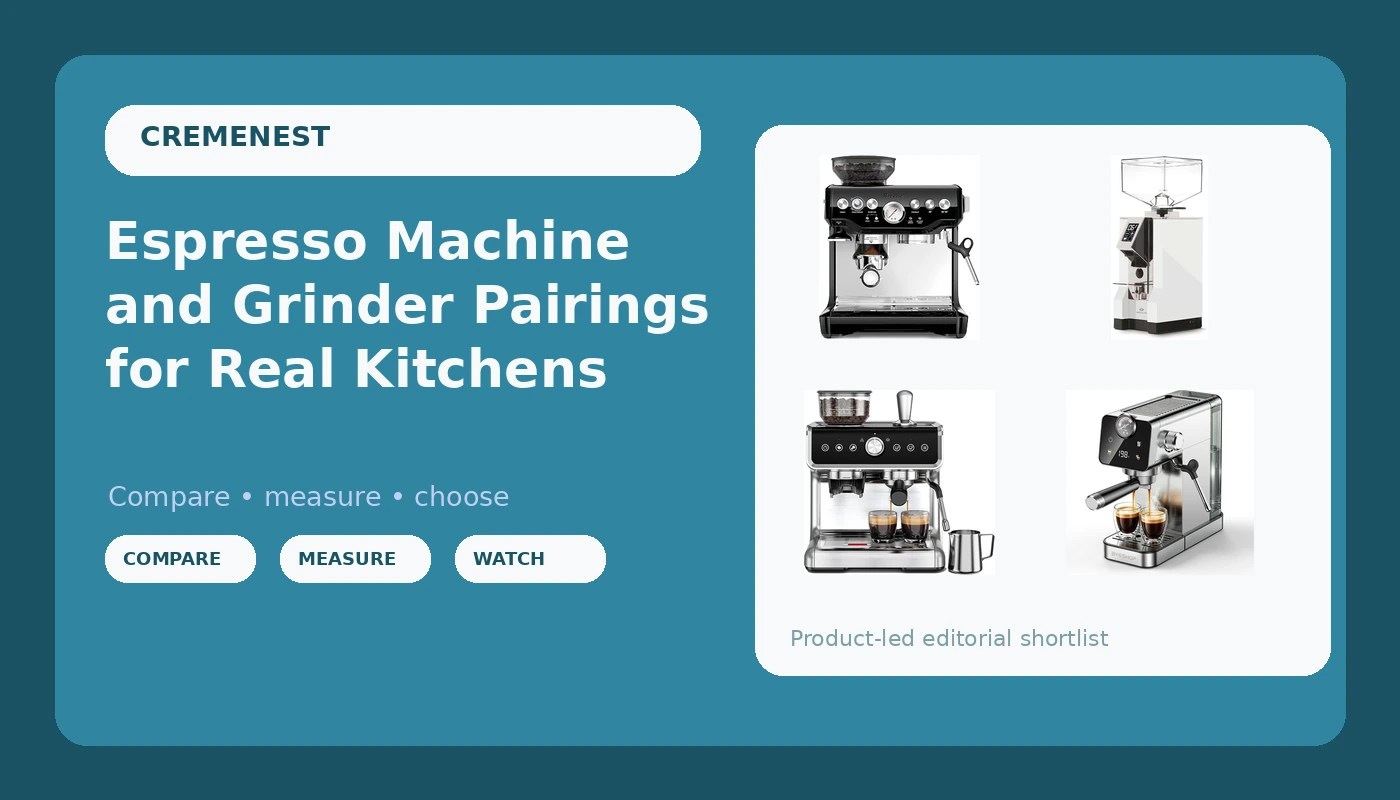
Most people building a home setup start with the machine and treat the grinder as an afterthought. That order is backwards. The espresso machine and grinder divide the work unevenly, and the half people skimp on is the half that decides whether a shot tastes sweet or sour. The machine controls pressure, temperature, and how pleasant the routine feels at 6:45 in the morning. The grinder controls the thing you actually taste.
This is an explainer, not a shootout. It covers how the two halves of a home setup split the job, what the numbers printed on the box really mean, and four options that represent different answers to the same question: what kind of morning do you want to keep having three months from now, when the novelty has worn off and the machine still needs to be worth the counter space?
Related: How to Choose a Home Espresso Grinder →
Quick answer
The grinder sets the ceiling on your espresso and the machine sets how easy the ceiling is to reach. If you are starting from nothing and want one purchase, the Breville Barista Express puts a machine and a grinder in a single footprint. If you already own a machine, or plan to keep one for years, the Eureka Mignon Specialita is the upgrade that changes the most cups. The EUHOMY Espresso Machine with Grinder and Milk Frother covers both jobs at a lower entry point, and the 20 Bar Compact Espresso Coffee Machines with Milk Frother is the option for a counter with no spare depth. Check current Amazon price on any of them before you commit, since listings move.
Four useful options
| Model | Best fit | What stands out |
|---|---|---|
| Breville Barista Express Espresso Machine, Black Sesame | One-purchase starting point | Machine and grinder in one footprint |
| Eureka Mignon Specialita Espresso Grinder | Grinder-first upgrade | Sound-insulated, stepless 55mm burrs, touchscreen |
| EUHOMY Espresso Machine with Grinder and Milk Frother, 20 Bar Pressure | Lower-cost all-in-one | Grinder and milk frother included, 20 bar rating |
| 20 Bar Compact Espresso Coffee Machines with Milk Frother for Home | Tight counter space | Compact body with milk frother, 20 bar rating |
The all-in-one starting point: Breville Barista Express Espresso Machine, Black Sesame
The appeal here is compression. You buy one thing, you learn one routine, and you never have to explain to a houseguest why there are two appliances on the counter. The built-in grinder is the part that shapes your expectations. It grinds fine enough to work with fresh beans, and it gives you a real dial to turn, but it is a convenience grinder sharing a body and a budget with the brewing hardware. That is the trade-off: your grinder can never be upgraded without replacing the machine too. If you want a setup you can grow into piece by piece, this is the wrong shape. If you want a setup you can use tomorrow morning without research, it is a reasonable one.
The honest framing is that this class of machine is a teaching tool as much as a coffee maker. You will learn what a choked shot feels like, what a gusher feels like, and how much a two-notch grind change moves the taste. That education transfers to any machine you own later, which is why so many people start here and eventually upgrade rather than starting somewhere else entirely.
The grinder-first upgrade: Eureka Mignon Specialita Espresso Grinder
Stepless adjustment is the detail worth understanding. A stepped grinder moves in clicks, so you sometimes land between a shot that runs too fast and one that chokes the machine, with nothing in between. Stepless means the burrs move continuously, so you can nudge the grind by a fraction instead of a click. On a light-roast bean that wants a very fine setting, that fraction is often the difference between a balanced shot and a sour one.
The 55mm burrs matter for the same reason a wider lens matters: more cutting surface generally means a more even particle distribution, and even particles extract at the same rate. Uneven particles mean some of the coffee is over-extracted and bitter while the rest is under-extracted and sharp, in the same cup. The sound-insulated housing is a practical feature rather than a performance one, and it matters more than people expect in an apartment or a house with early risers.
The trade-off is obvious: this is a grinder, not a machine. Buying it means your machine budget is separate, and you need to be honest about whether you own one already or intend to buy one. The argument for spending here first is that grinders age well. A good burr set stays good for years of home use, while machines come and go.
The lower-cost all-in-one: EUHOMY Espresso Machine with Grinder and Milk Frother, 20 Bar Pressure
This is the option for a household that drinks cappuccinos and lattes more often than straight shots. The frother is the reason to look here: milk texture is what separates a home latte from a cup of hot coffee with milk poured in, and having the frothing hardware in the same box removes a whole purchase decision.
The grinder and the brewer share a budget in this design, the same way they do in any all-in-one, so the ceiling is lower than a dedicated grinder plus a dedicated machine at the same total spend. That is not a flaw so much as a shape. You are buying convenience and a single delivery, and you should judge it on whether the milk drinks it makes are good enough that you stop thinking about upgrading. For a lot of kitchens, they are.
The compact counter pick: 20 Bar Compact Espresso Coffee Machines with Milk Frother for Home
Counter depth is the constraint nobody plans for. A full-size machine plus a separate grinder can eat most of a small kitchen's usable workspace, and a setup that has to be moved before you can cook is a setup that stops getting used. This machine's case is its footprint: it takes up the space it takes up, and the frother is built in, so there is no second appliance to house.
The trade-off runs in the same direction as the size. Compact machines generally carry smaller boilers and less thermal mass, which shows up in how quickly they recover between the shot and the steam and how steadily they hold temperature across a shot. If your routine is one drink at a time, that rarely matters. If you are making four drinks back to back on a weekend, it will. Buy for the workflow you will actually keep.
Prices and availability may change. Product images, names, and retailer links are matched to verified listings. No current price, rating, stock status, or measured result is stated here without current evidence.
Why the grinder decides the shot
Espresso is a narrow extraction window. You are pushing water through a compressed bed of coffee at pressure, and the taste depends on how evenly that water moves through the puck. Grind size controls the resistance, and resistance controls the flow, and flow controls how much of the coffee's solubles end up in the cup. Get the grind wrong and no amount of machine quality rescues the shot: too coarse and the water races through, leaving you with something thin and sour; too fine and the water stalls, leaving you with something bitter and harsh.
Consistency is the other half. A grinder that produces a wide spread of particle sizes produces a shot where different parts of the puck extract at different rates, which is why some shots taste simultaneously sour and bitter. That is a grinder problem, not a technique problem. It is also why pre-ground coffee is a dead end for espresso: you cannot adjust it, and it stales faster than whole beans, so you are locked into whatever the bag was ground for, which is never your machine.
This is the reasoning behind putting grinder money ahead of machine money. A modest machine paired with a capable grinder can produce genuinely good espresso, because the machine's job (steady pressure, steady temperature, a workable basket) is easier to do cheaply than the grinder's job. The reverse pairing, an expensive machine fed by an inconsistent grinder, mostly produces frustration with better build quality.
What 20 bar actually tells you
A 20 bar rating is a statement about the pump, not about the pressure at the puck. Espresso is conventionally brewed somewhere near 9 bar, and most machines that advertise 15 or 20 bar are running an over-pressure valve that limits what reaches the coffee. The high number is a marketing shorthand for "this pump has headroom," not a claim that more pressure makes better coffee. If anything, uncontrolled high pressure at the puck tends to amplify channeling, where water finds a weak path through the bed and leaves the rest of the coffee under-extracted.
The specifications that change what you taste are less photogenic. Temperature stability across the shot is the one you feel every single time, because a brew temperature that drifts produces a cup that is sometimes sweet and sometimes sharp with no change in your technique. Recovery time between brewing and steaming matters if you make milk drinks, since a machine that needs a long pause between the two turns a two-minute routine into a five-minute one. Portafilter size matters because larger baskets hold deeper pucks, which are more forgiving of small distribution errors. And boiler design sets the ceiling on all of it.
None of that appears on the front of the box. It is why the useful question is not "how many bars" but "what does this machine do after the first shot."
- Decide how many drinks you make per session, since that determines whether recovery time matters.
- Decide whether milk is part of the routine, since that determines whether you need a frother or a steam wand.
- Measure the counter depth and height you can actually spare before comparing machines.
- Decide whether the grinder will be separate, because that decision locks in your upgrade path.
- Set one total budget and split it deliberately, rather than spending it all on the more visible half.
Building a workflow your counter can actually support
- Grind fresh, right before the shot. A grinder you enjoy using is one you will actually use every morning.
- Keep beans within a few weeks of roast. Stale beans force you to grind finer to compensate, which usually means a worse-tasting shot.
- Plan for water. Filtered water reduces scale, and scale is what kills budget machines early.
- Account for cleaning time. A routine that takes four minutes to clean will not survive a busy week.
- Buy for the drinks you make most, not the drinks you make when guests visit.
Which option should you choose?
Choose the Breville Barista Express Espresso Machine, Black Sesame when you want a single purchase, a single footprint, and a gentle path into learning espresso without assembling a station from separate parts. Choose the Eureka Mignon Specialita Espresso Grinder when you already own a machine or plan to keep one for years, and you want the upgrade that improves every cup you make from here on. Choose the EUHOMY Espresso Machine with Grinder and Milk Frother, 20 Bar Pressure when milk drinks are the point and you want the grinder, the brewer, and the frother in one box. Choose the 20 Bar Compact Espresso Coffee Machines with Milk Frother for Home when counter depth is the constraint and one drink at a time is your normal routine.
One caveat applies to all four. Listing details, included accessories, and availability change, and no machine or grinder here has been measured or tested for this article, so treat the specifications above as what the listings state rather than as results. Confirm dimensions against your own counter, and confirm what is included in the box before ordering. If you are weighing a dedicated grinder against an all-in-one, the deciding question is not which makes better coffee today. It is which one you will still be happy to use after the third month.
The bottom line
An espresso machine and grinder are not equals in the cup. The grinder determines how good your espresso can be, and the machine determines how pleasant it is to produce it, which is why a budget split that favors the grinder usually outperforms the reverse. If you want one box and a short learning curve, the Breville Barista Express is the all-in-one starting point. If you want the upgrade that keeps paying off across future machines, the Eureka Mignon Specialita is the grinder-first choice. If milk drinks and budget come first, the EUHOMY all-in-one covers grinder, brewer, and frother together. And if your counter is the real constraint, the 20 Bar Compact machine is built for the space you have rather than the space you wish you had. Check current Amazon price on each before you decide.