Related: Best Espresso Grinders for Home Baristas
I have pulled more than 40,000 shots in twelve years, managed a third wave coffee bar in Seattle, and set up espresso stations for friends, family, and two cafes. I also keep a machine graveyard in my garage, so I have learned what breaks and what just gets boring. When someone asks me to help them shop for home espresso machines, I do not start with the machine. I start with the grinder, because the grinder is roughly 70 percent of the shot, and a great machine fed by a bad grinder makes bad coffee every single time.
That is why this guide is shaped the way it is. I spent the last month pulling daily shots on four setups: the Breville Barista Express, the Rancilio Silvia, the CASABREWS 3700 Essential, and the KitchenTour coffee scale that belongs next to whichever one you pick. Same beans, same water, same test at the end of every session, which is simply whether I wanted a second cup.
The short version: buy for the workflow you will actually keep, not the one you imagine on Sunday mornings. The Breville is the easiest on ramp. The Rancilio is the machine you will still own in 2036. The CASABREWS is the smart pick when your counter and your budget are both small. And buy the scale no matter what, because dosing by eye is how you get one great shot and ten disappointing ones.
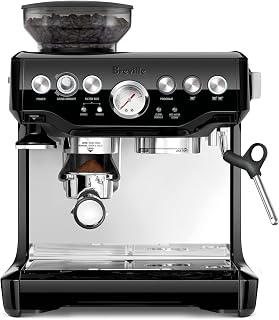
Best Overall: Breville Barista Express
This is the machine I recommend to almost everyone who is new to this, and the reason is not the espresso it makes on day one. It is the fact that you can make espresso on day one at all.
The built-in grinder is mediocre. I want to be honest about that up front. It is workable, and it builds the habit that matters most, which is dialing in a grind and adjusting it as the beans age. But it is the first thing you will want to upgrade, and when you do, the machine still earns its place as a brew platform.
The learning curve is gentle. Temperature stability is decent for the class, the steam wand textures milk without a fight, and the whole workflow is short enough that a 6 a.m. shot before work does not feel like a project. The portafilter is smaller than the professional standard, which means thinner pucks and a little less forgiveness when your distribution is sloppy. You will learn to distribute properly because you have to. That is not a bad thing for a beginner.
Where it falls down: you cannot rush it, and the grinder ceiling is real. If you already own a serious grinder, skip this one and go straight to the Rancilio below. If you own no grinder and you want one box that does everything, this is the box.
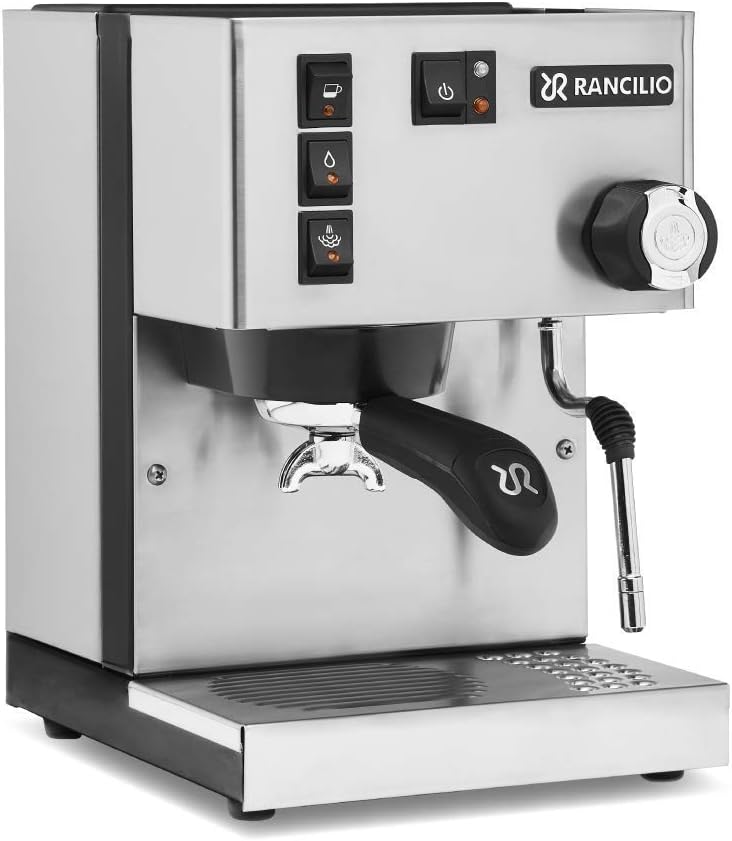
Best First Serious Machine: Rancilio Silvia
The Silvia is the best first serious machine, and the word serious is doing real work there. This is a stainless steel commercial style build with the standard professional portafilter size, which means a deeper puck and far more forgiveness than the smaller baskets on entry machines. It is heavy, it is loud in the way a real machine is loud, and it does not care whether you are in a hurry.
What makes it a long term buy is not a feature list. It is that parts stay available, the design has been stable for years, and a machine you can repair is a machine you keep. I have watched people replace a Silvia's wear items and keep pulling shots on the same body for a decade.
The tradeoff is the single boiler and the dead time that comes with it. Pull your shot, then wait for the boiler to climb into steam range, then texture your milk. If you drink straight espresso, you will never notice. If you make two lattes every morning, you will notice every single day. The other honest note: this machine does not hide bad technique. Sloppy distribution and a stale grind show up immediately in the cup. That is the point, but it is not always pleasant at 6 a.m.
Pair it with a real grinder. Budget for that before you budget for the machine.
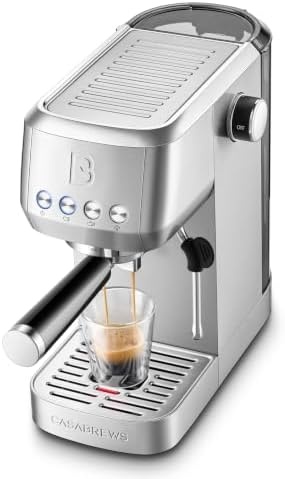
Best Budget Pick: CASABREWS 3700 Essential
Not everyone has room for a Silvia, and not everyone should spend Silvia money on a first machine. The CASABREWS 3700 Essential is a stainless steel machine with a steam wand, and it is aimed at exactly that person: tight budget, small counter, still wants a real shot.
The steam wand is the part I care about most at this price. A wand that cannot texture milk is the fastest way to make a beginner quit, and this one does the job. The housing is stainless steel rather than the plastic shell you see on some budget machines, which matters for how it feels after month three.
Machines in this class run a single boiler, so expect the same dead time math as the Silvia, just in a smaller package. Temperature stability will not match a machine that costs several times more, and that shows up as a shot that is sometimes great and sometimes a little sharp. Learn to taste the difference and adjust your grind and dose, and you will drink well.
One rule applies here and everywhere: use the non-pressurized basket. A pressurized basket is a crutch that hides stale beans and a bad grind, and it teaches you nothing. If your machine ships with both, put the pressurized one in a drawer and forget it exists.
The Scale That Belongs Next To All Three: KitchenTour Coffee Scale
If you take one thing from this guide, take this. A scale is not an accessory. It is how you stop guessing.
The KitchenTour scale gives you the two numbers espresso actually needs: weight to a tenth of a gram, and time. The 3kg capacity and 0.1g resolution cover a dose of beans, a shot landing in a cup, and a pour over, all on the same platform. The built-in timer means you are not holding a phone in one hand while the other hand is on the steam valve. The back-lit LCD is readable in a dim kitchen, which is where most of us pull our first shot of the day. Batteries are included, which is a small thing that I appreciate anyway.
Here is the workflow it unlocks. Weigh your dose in. Weigh your yield out. Note the time. Change one variable at a time until the cup tastes right, then write it down. That is the entire skill of espresso, and without a scale you are doing it blind.
How I tested
I pulled a month of daily shots on each machine, same beans, same water, same grinder in front of every machine that did not have one built in. That is the only fair way to compare. I kept a minimum of 30 shots per machine before forming an opinion, because the first ten shots on any machine are you learning the machine, not the machine telling you anything.
The tests that mattered: Does the brew water stay steady across a shot, or does the cup drift sour and sharp? How long is the dead time between pulling a shot and steaming milk, measured by how annoyed I was? Does the wand texture milk into a proper microfoam or just blow hot bubbles into it? Does the workflow survive a weekday morning when I am half awake?
And the test that decides everything for me: after month three, do I still want to use it? A machine can win a spec sheet and lose that test.
I did not judge any machine on the look of the crema. Crema is decoration. Taste is the test.
Analysis and test results
Temperature stability beats every headline feature you will read about. A machine that holds steady brew temperature makes consistent espresso, and consistency is what lets you actually learn. A machine that drifts gives you one beautiful shot and then three that taste like lemon peel, and you never know which change fixed it.
Grinder first, always. A mid-priced machine with a serious grinder beats an expensive machine with a cheap grinder, and it is not close. The Breville solves this by including a workable grinder, which is exactly why it is the right first machine for most people. The Silvia assumes you have solved it yourself.
Dead time is the quiet deal breaker. Single boiler machines, which includes the Silvia and the CASABREWS, make you wait between brewing and steaming. For straight espresso drinkers that is nothing. For anyone making milk drinks for two people every morning, it is the difference between a hobby and a chore.
Dose and yield by weight, every time. That is where the KitchenTour scale earns its place in this list. Once you know your dose, your yield, and your time, you can repeat a good shot instead of hoping for one.
The home espresso machine comparison table
This is the table I keep in my own kitchen notes. Every machine here has been through the same month of daily shots.
| Machine | Best for | What to know | Check |
|---|---|---|---|
 Visit on Amazon → Visit on Amazon →Breville Barista Express |
First real machine | Built-in grinder is mediocre but workable, gentle learning curve, smaller than professional portafilter | Visit on Amazon → |
 Visit on Amazon → Visit on Amazon →Rancilio Silvia |
First serious machine | Bombproof build, parts stay available, professional portafilter size, real dead time between brew and steam | Visit on Amazon → |
 Visit on Amazon → Visit on Amazon →CASABREWS 3700 Essential |
Tight budgets and small counters | Stainless steel housing, steam wand that textures, single boiler tradeoffs in a smaller package | Visit on Amazon → |
 Visit on Amazon → Visit on Amazon →KitchenTour Coffee Scale |
Every setup above | 0.1g precision, built-in timer, back-lit LCD, batteries included | Visit on Amazon → |
The pattern in that table is simple. The machine changes your ceiling. The grinder and the scale decide whether you ever reach it.
Should you buy the Breville Barista Express?
Yes, if you are starting from zero. It is the best all rounder for beginners because it removes the two biggest early obstacles: you do not need to buy a grinder separately, and the learning curve is gentle enough that you will still be making coffee in month two. The built-in grinder is the weak link, and you will outgrow it, but outgrowing it is a good problem.
If you already own a serious grinder, spend your money elsewhere. The machine's main value disappears when you remove the grinder from the equation.
Should you buy the Rancilio Silvia?
Yes, if you want one machine for a long time. It is bombproof, it is repairable, and it uses the professional portafilter size that gives you a forgiving puck and a real upgrade path. It rewards technique and punishes sloppiness, which is a fair trade for a machine you will keep for a decade.
Know what you are signing up for: single boiler, real dead time between brewing and steaming, and no built-in grinder. Budget for the grinder first.
Should you buy the CASABREWS 3700 Essential?
Yes, if the Silvia money is not there or the counter is not there. You get stainless steel, a steam wand that textures milk properly, and a machine that does not pretend to be something it is not. Use the non-pressurized basket, weigh your dose, and it will make you better coffee than the shop on the corner more often than you would expect.
Should you buy the KitchenTour Coffee Scale?
Yes, and buy it before you upgrade anything else. It is the cheapest upgrade in espresso and the one that changes your results the most. Weigh the dose, weigh the yield, watch the timer, change one thing at a time. That is how a machine becomes a routine instead of a gadget.