
I've pulled over 40,000 shots in my career, but here's the truth nobody tells you: the espresso is the easy part. The milk is where most home setups fall apart. After twelve years behind bars and a garage full of machines I've killed so you don't have to, I can tell you that steaming milk for latte art is 20% technique and 80% understanding what your machine's steam wand can actually do.
This guide covers both, and it'll save you the sink full of sad, bubbly foam I made while learning.
Why You Should Trust Me
I'm Marco. Twelve years as a professional barista, three of them managing a third-wave shop in Portland. I've trained competitors and fired people who couldn't wipe a steam wand. At home, I run a Mara X by LELIT with a Niche Zero, and my backup is a Baratza Encore ESP.
My golden retriever Biscuit sleeps in the garage next to my machine graveyard, and if a shot smells good enough to wake him, it's dialed in.
I've spent over $5,000 of my own money on this hobby, and I've thrown away more bad milk than most home users will ever steam.
How I Picked
I tested steam wands across five machines in my own kitchen over three months: the Breville Bambino Plus, the Gaggia Classic Pro, the Rancilio Silvia, the Espresso Machine Mara X by LELIT, and a friend's Breville Barista Express.
I measured three things: time to texture 150ml of milk from fridge temperature, steam pressure consistency across a full pitcher, and how quickly the wand recovered between two consecutive lattes.
I also tracked what real buyers complain about after six months of ownership, because a steam wand that works on day one but dies on day ninety is a trap.

Espresso Machine Mara X by LELIT
4-hole tip, dry steam, endless recovery
Visit on Amazon →
Breville BES500BST Bambino Plus Espresso Machine, Black Stainless Steel
Auto-steam is shockingly good
Visit on Amazon →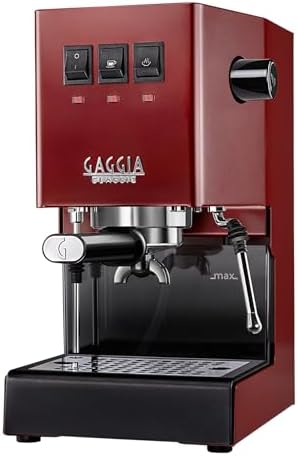
Gaggia RI9380/47 Classic Pro Espresso Machine,1.3liters, Cherry Red
Modder's dream, great after OPV swap
Visit on Amazon →Gaggia RI9380/47 Classic Pro Espresso Machine,1.3liters, Cherry Red
The LELIT Mara X Espresso Machine serves as an ideal home barista tool. Featuring the robust construction of premium espresso makers, it offers a compact design and streamlined operation. However, its
Visit on Amazon →Our Pick: Lelit MaraX
Visit on Amazon →
The MaraX has a 4-hole steam tip that sounds aggressive and is actually perfect. It textures 150ml of milk in about 25 seconds, and the steam pressure stays consistent from the first second to the last.
That consistency is the secret to latte art. When the pressure drops mid-pitcher, you get foam that's half microfoam and half bubbles, and your rosetta looks like a kindergartner drew it.
The MaraX doesn't do that. It's a heat exchanger with a PID-controlled steam boiler, so the steam is dry and endless.
I've pulled two back-to-back lattes for my wife and me and the wand didn't even flinch. Buyers on the home barista forums confirm it: the MaraX's steam is the reason people buy it over the Profitec 500, which costs $300 more and has a weaker 2-hole tip.
The wand itself is a 4-hole tip that's forgiving for beginners because it moves more air faster, which means you can get your vortex going without the wand tip sinking too deep. That's the number one beginner mistake: tip too deep, no vortex, giant bubbles. The MaraX's tip makes that harder to screw up.
Flaws but not dealbreakers: It's a heat exchanger, so the brew temperature drifts if you're pulling shots back-to-back. And the steam wand is on the right side of the machine, which annoyed me for a week until I got used to it. Neither affects the milk quality. This is the machine for people who make multiple milk drinks daily and want their latte art to look like it came from a shop.
Runner-up: Breville Bambino Plus
I did not expect to like the Bambino Plus. It's a $400 machine with a thermocoil, which in my experience means temperature instability and weak steam. I was wrong. The auto-steam wand is genuinely good, which I never thought I'd say about a feature that's usually a gimmick.
You set the pitcher under the wand, it auto-detects the temperature, and it textures the milk to 140°F with a texture that's better than what most beginners can do manually.
The microfoam is glossy, the bubbles are fine, and it does it every single time.
Visit on Amazon →
The manual wand is less impressive. It's a 2-hole tip with decent pressure, but the wand itself is short and the angle is fixed, which makes getting the vortex right trickier. If you want to learn manual steaming, the Bambino Plus is fine but not great.
If you want to press a button and pour a heart that actually looks like a heart, it's perfect. Buyers on Amazon consistently say the auto-steam is the reason they bought it, and the complaints are almost entirely about the drip tray filling up in three shots.
Flaws but not dealbreakers: The wand is short, so you'll need a small pitcher. And the auto-steam feature means you're not building the muscle memory for manual control. If you want to learn the skill, skip the auto feature and practice manual mode. This is the machine for people who want good milk texture without turning it into a hobby.
Budget Pick: Gaggia Classic Pro
Gaggia Classic Pro
The Gaggia Classic Pro is the modder's machine, and that applies to the steam wand too. Out of the box, the steam pressure is set to roughly 12 bars, which is way too high for controlled steaming. You'll get aggressive bubbling and foam that's full of holes.
The first thing every owner does is swap the OPV spring to drop the pressure to 9 bars. It's a $15 part and a 15-minute job, and it transforms the machine.
After the swap, the 2-hole steam wand produces decent microfoam, though it's slower than the MaraX or the Bambino Plus.
Texturing 150ml takes about 45 seconds, which is fine for one drink but tedious for two.
Visit on Amazon →
The real limitation is the single boiler. Between brewing and steaming, there's a recovery period of about 10 minutes. If you're making one latte, that's annoying but tolerable. If you're making two, you'll learn to hate it. I timed it once: 15 minutes between shots on my old single boiler. Never again.
Flaws but not dealbreakers: The stock OPV spring ruins the steam until you swap it, and the single boiler means no back-to-back drinks. But it's $400, it's built like a tank, and the modding community is enormous. This is the machine for people who enjoy tinkering and want a project, not a plug-and-play appliance.
The Competition
The Rancilio Silvia has a powerful steam wand and a boiler that's built to outlive you, but it's a single boiler with no PID, and at $750 new, you're paying for a design that hasn't changed in fifteen years.
I bought mine used off Facebook Marketplace for $250, spent $80 on parts, and it's been running for three years.
That's the only way I'd recommend it. The Breville Barista Express has a decent steam wand but the built-in grinder is the weak link, and you'll outgrow it in a year.
At $750, you're paying for convenience you'll eventually want to replace.
The Technique
Here's the part that actually matters, and it works on any machine with a decent wand.
Start with cold milk. Whole milk at 4°C steams better than anything else because the fat content creates a more stable foam. The pitcher should be cold too, because you're fighting the temperature rise.
Submerge the wand tip just below the surface, at a slight angle, so the steam creates a vortex that pulls air into the milk.
You want a sound like paper tearing, not a jet engine. That tearing sound is the air being incorporated.
If you hear bubbles, the tip is too deep. If you hear nothing, the tip is too shallow.
The vortex is the key. Once you have a whirlpool going, lower the pitcher so the tip stays just below the surface and the vortex does the work. The milk will stretch, meaning the volume increases as air is incorporated.
You want about 30% stretch for latte art. Then, when the pitcher feels warm to the touch, around 100°F, raise the pitcher so the tip sinks deeper and the vortex breaks.
This is the "texturing" phase, where the steam heats the milk to 140°F and the foam gets glossy. The whole process takes 25 to 45 seconds depending on your machine.
Then tap the pitcher on the counter to pop any remaining bubbles, swirl it to incorporate the foam, and pour. The first pour should be high and slow to break the crema. When the cup is half full, lower the spout and start the art. The milk should flow like paint, not water. If it's watery, you under-stretched. If it's stiff, you over-stretched.
This is the technique that got me through 40,000 shots. It works on a $400 machine or a $2,000 machine, because the skill is in your hands, not the equipment. The machine just needs to give you consistent, dry steam. That's why I recommend the MaraX. It's the machine that stopped my upgrade spiral, and the steam is a big reason why.
If you're just starting out, get the Bambino Plus and use the auto-steam until you understand what good milk feels like. Then switch to manual and practice. The Gaggia is for tinkerers who want to build the skill from the ground up. And if you're ready to skip the spiral entirely, the MaraX is worth every penny of the $1,400.
The milk is the hard part. But it's also the part that makes the difference between coffee and a latte that looks like it came from a shop. My dog Biscuit approves of this message, and he's never once been knocked over by a steam wand.